
Cerebras Debuts, H200 Limbo, Courts Weigh In
From a blockbuster AI chip IPO to Nvidia’s paper approvals in China, Cisco’s AI pivot, a pivotal authors-versus-Anthropic hearing, and NIST’s push on AI incident playbooks—here’s what matters and why. Ten minutes, all signal.
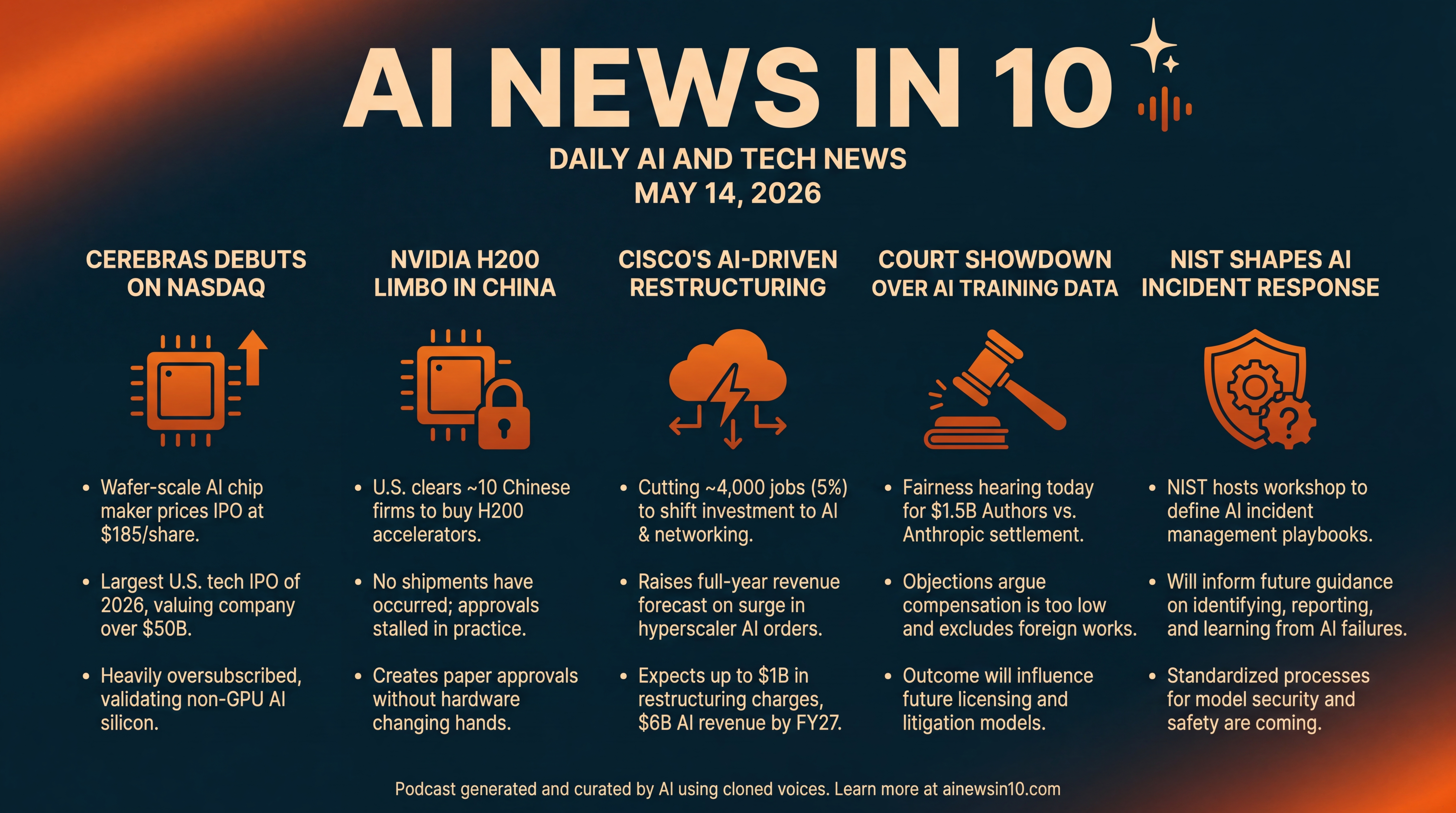
Episode Infographic
Show Notes
Welcome to AI News in 10, your top AI and tech news podcast in about 10 minutes. AI tech is amazing and is changing the world fast, for example this entire podcast is curated and generated by AI using my and my kids cloned voices...
It’s Thursday, May 14, and today’s rundown has everything from a blockbuster AI chip IPO... to a rare export green light on Nvidia hardware... to new moves in AI policy and a court showdown over training data. We’ll unpack Cerebras’ debut on Nasdaq, the U.S. clearing sales of Nvidia’s H200 accelerators to roughly ten companies in China—with a big asterisk—Cisco’s AI-driven restructuring, a pivotal fairness hearing in the authors versus Anthropic class action, and a NIST workshop that could shape how organizations handle AI incidents going forward. Buckle up... lots to cover in ten minutes.
[BEGINNING_SPONSORS]
First up... Cerebras steps onto the public stage.
The wafer-scale AI chip maker priced its IPO at 185 dollars a share—above an already raised range—and begins trading today on Nasdaq under the ticker CBRS. That pricing implies roughly 5.55 billion dollars raised, and a fully diluted valuation north of 50 billion... making it the largest U.S. tech IPO of 2026 so far.
Multiple reports say the deal was heavily oversubscribed after Cerebras boosted the range earlier this week and upsized the offering from 28 to 30 million shares. It’s a statement moment for non-GPU silicon in the AI stack.
Why investors care... Cerebras sells wafer-scale systems pitched as faster for certain inference and training tasks than conventional GPU clusters, and has touted big-ticket partnerships. If the stock trades well, it could validate the thesis that specialized AI hardware can carve out durable niches alongside Nvidia and AMD. Of course... day-one pops can fade. Watch lockup dynamics, early customer concentration risk, and the near-term margin profile as those systems scale into real deployments. Ahead of the debut, backgrounders noted 2025 revenue around 510 million dollars and a sharp swing to profitability—figures investors will now parse against public quarterly reporting.
Story two... a notable—and nuanced—policy move in chips.
The U.S. has cleared roughly ten Chinese companies to buy Nvidia’s H200 accelerators—Nvidia’s second most powerful AI chip today—yet not a single shipment has actually occurred. Lenovo publicly confirmed it’s among the approved distributors, but approvals have stalled in practice as Chinese authorities steer domestic firms toward homegrown silicon. So, licenses are granted... but deliveries are stuck.
Markets noticed: Nvidia shares ticked higher pre-market on the headlines, but the real story is the limbo—paper approvals without hardware changing hands. For developers in China, that limbo means continued constraints on state-of-the-art compute. For Nvidia, it’s a faint path back into a once-massive market that remains politically fraught.
A quick footnote... Analysts point out that even limited H200 access could reshape the competitive balance between Chinese cloud players—if, and only if, the chips actually ship. Until then, software workarounds and second-tier accelerators will continue to define many stacks inside the Great Firewall. We’ll keep tracking whether those paper approvals translate into fulfilled purchase orders.
Third story... Cisco’s AI pivot just got sharper.
The company says it will cut nearly 4,000 jobs—about five percent of its workforce—in a restructuring aimed squarely at shifting more investment toward AI, security, silicon, and next-gen networking. At the same time, Cisco raised its full-year revenue forecast, citing a surge in hyperscaler orders tied to AI data center buildouts. Management expects up to 1 billion dollars in restructuring charges—roughly 450 million recognized this quarter and the balance in fiscal 2027. The stock popped on the outlook—another sign that Wall Street is rewarding vendors that can ride AI infrastructure demand while trimming legacy exposure.
Cisco’s finance chief even called it “reasonable” to expect at least 6 billion dollars of AI hyperscale revenue in fiscal 2027—a data point that helps quantify how fast networking dollars are following accelerator capex. Read between the lines: as cloud providers race to stand up rack after rack of AI compute, they’re also refreshing spine and leaf fabrics, optical interconnect, and Ethernet-based AI networking—areas where incumbents see a chance to reaccelerate growth. But the human cost is real: thousands of roles are being reshaped or removed in the name of that pivot.
[MIDPOINT_SPONSORS]
Fourth today... a consequential courtroom moment in the ongoing clash over AI training data.
At 2:00 p.m. Pacific today in San Francisco—yes, later this afternoon—the federal court will hold a fairness hearing in the Bartz v. Anthropic class action settlement. Authors and publishers reached a proposed settlement worth 1.5 billion dollars last fall over the use of books to train Anthropic’s models, with payments estimated around 3,000 dollars per covered work—roughly 500,000 works in total. Today’s hearing will air objections that argue, among other things, that the plan favors publishers over authors, that compensation is too low versus statutory damages, and that foreign works were unfairly excluded from the class. The judge has allowed certain objections to be unsealed, and the proceedings can be attended on Zoom. Whatever the outcome, this case will influence how future licensing—or litigation—over training data is structured.
Context... If approved, the settlement would set a headline dollar figure and a framework that other rightsholders and AI developers will study—and likely contest. If rejected or revised, expect fresh negotiations, narrower subclasses, or more protracted litigation. Either way, the court’s read on notice, fairness, and scope will echo through the creative industries, academia, and the AI labs scrambling to secure clean, licensable corpora.
And fifth... the U.S. is moving toward more structured playbooks for AI mishaps.
NIST is hosting a two-day workshop—May 13th and 14th—on AI incident management. The goal is to gather input on how organizations should identify, report, triage, and learn from incidents where AI systems are the target or the source of harm. Think model-enabled security failures, unsafe autonomous behaviors, or data leakage pathways unique to AI. NIST says the takeaways will inform future guidance from its Information Technology Laboratory and the Commerce Department’s Center for AI Standards and Innovation. If you’re responsible for model operations or security, this is a signal that standardized incident language and response processes are coming.
Why it matters... AI incidents aren’t just bugs—they can be systems-level failures involving data pipelines, third-party models, or autonomous agents interacting with the real world. Common taxonomies and reporting norms make it easier to compare events, share mitigations, and ultimately harden the ecosystem. Expect eventual links between incident management and audits, red teaming, and procurement requirements in critical sectors.
Quick recap... Cerebras begins trading after pricing above the range—this year’s marquee AI chip IPO so far. The U.S. cleared H200 sales to roughly ten firms in China, but shipments haven’t started. Cisco is cutting about 4,000 roles as AI orders surge and guidance rises. A major class action settlement over training data hits a fairness hearing in San Francisco this afternoon. And NIST is laying the groundwork for how the U.S. will handle AI incident response. We’ll keep an eye on the opening print for CBRS, any movement on those Nvidia approvals, and—of course—the court’s next steps... more tomorrow.
Thanks for listening and a quick disclaimer, this podcast was generated and curated by AI using my and my kids' cloned voices, if you want to know how I do it or want to do something similar, reach out to me at emad at ai news in 10 dot com that's ai news in one zero dot com. See you all tomorrow.
