Big Bets, Deepfake Shields, and Money Chats
Wall Street backs Microsoft’s AI flywheel, YouTube opens deepfake likeness alerts to all adults, and OpenAI connects ChatGPT to your finances — opt-in only. Plus, a school-district mega-case narrows ahead of Meta’s June trial as Congress moves to hard-wire NIST’s AI playbook across government.
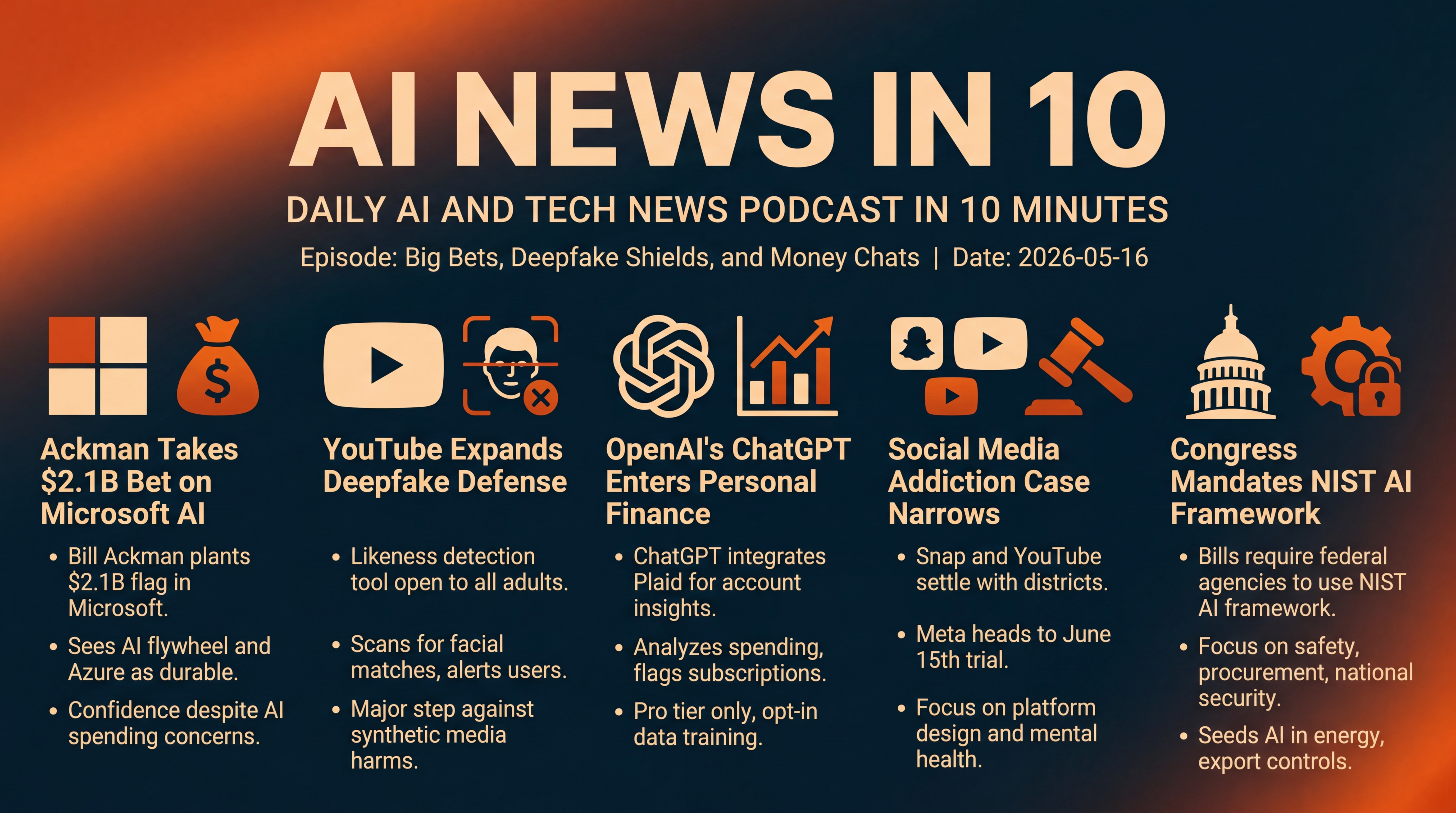
Episode Infographic
Show Notes
Welcome to AI News in 10, your top AI and tech news podcast in about 10 minutes. AI tech is amazing and is changing the world fast, for example this entire podcast is curated and generated by AI using my and my kids cloned voices...
Here’s what’s moving in AI and tech on Saturday, May sixteenth, 2026... We’ve got a big Wall Street vote of confidence in Microsoft’s AI future, a major expansion of YouTube’s deepfake defense tools for everyday users, OpenAI nudging ChatGPT into your personal finance life, a closely watched social media addiction case that’s narrowing before a June court date, and a fresh batch of Capitol Hill proposals that would hard-wire the government to the NIST AI Risk Management Framework while seeding AI across energy and security. Let’s dive in.
[BEGINNING_SPONSORS]
Story one — Bill Ackman just planted a two point one billion dollar flag in Microsoft.
The Pershing Square founder says he’s been quietly buying since February, calling Microsoft 365 and the Azure cloud two of the most valuable franchises in enterprise technology. The stake is tiny relative to Microsoft’s market cap — under a tenth of one percent — but the timing matters. He framed it as taking advantage of recent weakness as investors worry about AI spending and Azure’s growth.
The bet, simply put, is that Microsoft’s AI flywheel — from Copilot, to frontier model access, to a one hundred ninety billion dollar, multi-year capital plan — will drive durable cash flows that many are underestimating. Ackman’s comments were updated overnight... hot off the presses for May sixteenth.
Why it matters — we’re in the “show me” phase of AI. Giant checks for data centers and silicon are colliding with investor patience. A marquee activist taking the other side — that Microsoft’s operating system for work will monetize across subscriptions, usage, and cloud — adds signal in a noisy market.
Story two — YouTube is opening its AI deepfake likeness detection tool to everyone eighteen and up.
It was previously limited to creators, public officials, journalists, and entertainment pros. Now any adult can opt in by submitting a selfie-style scan. YouTube will scan the platform for facial matches and alert you if it finds a likely look-alike, so you can request removal under its privacy rules.
There are carve-outs — labeled parody or satire, for example — and the tool covers faces, not voices. You can withdraw at any time and have your scan deleted. Historically, only a small share of detections led to takedown requests... but expanding eligibility to the full adult user base is a real line in the sand in the fight against synthetic media.
This is significant for two reasons. First, the harms are moving downstream from celebrities to private citizens — classmates, coworkers... anyone. Second, making detection a user-level control creates a feedback loop that can inform platform enforcement, especially as elections and other high-stakes moments bring a surge of manipulated content.
Story three — OpenAI wants ChatGPT to see your money... literally.
A new preview integrates Plaid so Pro subscribers can securely connect checking, credit, and investment accounts, then ask ChatGPT to analyze spending, flag subscriptions, or compare credit cards — all inside the chat.
OpenAI says it won’t see full account numbers or move money. You can disconnect at any time, and there’s a thirty-day window to delete linked financial data. Training on your financial content is opt-in through the “Improve the model for everyone” setting. The feature launches first for the Pro tier in the United States at two hundred dollars per month, with plans to broaden later. After January’s health assistant, the pitch is clear — health... then wealth.
Let’s be candid — connecting your balance sheet to a chatbot raises as many questions as it answers. Benefits like a unified view and anomaly flags are compelling — but the risk calculus now includes data retention, breach exposure, and the gray zone of financial memories. If this sticks, expect quick copycats across personal finance — and expect regulators to ask sharper questions about consent, deletion, and auditability.
[MIDPOINT_SPONSORS]
Story four — a landmark school district case over social media addiction is narrowing.
Snap and YouTube — and reportedly TikTok — have reached settlements in the first trial brought by public school districts, which argue platform design fueled a student mental health crisis and forced districts to spend big on mitigation. That leaves Meta heading toward a June fifteenth trial date in federal court in Oakland, California. Terms were not disclosed.
This case is a bellwether for more than a thousand similar suits nationwide. Settlements aren’t admissions — but they do reset the courtroom map just weeks before jury selection.
Zooming out — whether through verdicts or settlements, platforms are being pulled into the same accountability orbit we saw with tobacco and opioids — discovery, design-choice scrutiny, and algorithmic-impact analysis. For tech, this dovetails with a broader regulatory push on minors’ safety and synthetic-content labeling. Watch June fifteenth closely... even the posture of that trial could shape a wave of negotiations.
Story five — Congress is sharpening the government’s AI playbook.
A slate of bipartisan, cross-committee bills introduced this week would do a few notable things. They would require federal agencies that use AI to follow NIST’s AI Risk Management Framework — govern, map, measure, manage. They would direct State Department export-control teams to incorporate AI for risk analysis. They would accelerate AI-assisted research and development in next-generation geothermal energy. And they would lock down connected-vehicle hardware and software linked to foreign adversaries.
The common thread is operationalizing AI while putting rails around safety, procurement, and national security. These proposals were filed between May seventh and May fifteenth, and are now headed to their respective committees.
Why this matters right now — agencies are racing to deploy AI in benefits, fraud detection, and cybersecurity... but without uniform standards you get uneven risk practices and vendor sprawl. Making the NIST AI framework mandatory wherever AI is used would set a baseline for testing, documentation, and oversight — and, for vendors, a clearer compliance target. Paired with energy and export-control measures, this is Washington attempting to scale responsible AI beyond white papers.
Quick recap before we go...
Ackman’s two point one billion dollar Microsoft wager says the AI enterprise stack still has legs. YouTube’s likeness detection opens deepfake defense to every adult. OpenAI is putting ChatGPT on your budget and brokerage — opt-in only, for now. A school-district mega-case narrows as Meta heads for a June fifteenth trial. And Congress is moving to make the NIST AI risk framework the federal default while seeding AI across energy, export controls, and connected-vehicle security.
That’s your AI News in Ten for Saturday, May sixteenth.
Thanks for listening and a quick disclaimer, this podcast was generated and curated by AI using my and my kids' cloned voices, if you want to know how I do it or want to do something similar, reach out to me at emad at ai news in 10 dot com that's ai news in one zero dot com. See you all tomorrow.
