Fast16 Deception, Malta’s AI Bet, Foxconn Fallout
From a newly decoded Stuxnet‑era deception to Malta’s nation‑scale AI pilot, we break down five stories shaping the week — including early labor shifts, Foxconn’s ransomware hit, and the rise of local data center moratoriums. Plus a quick look ahead to Google I/O.
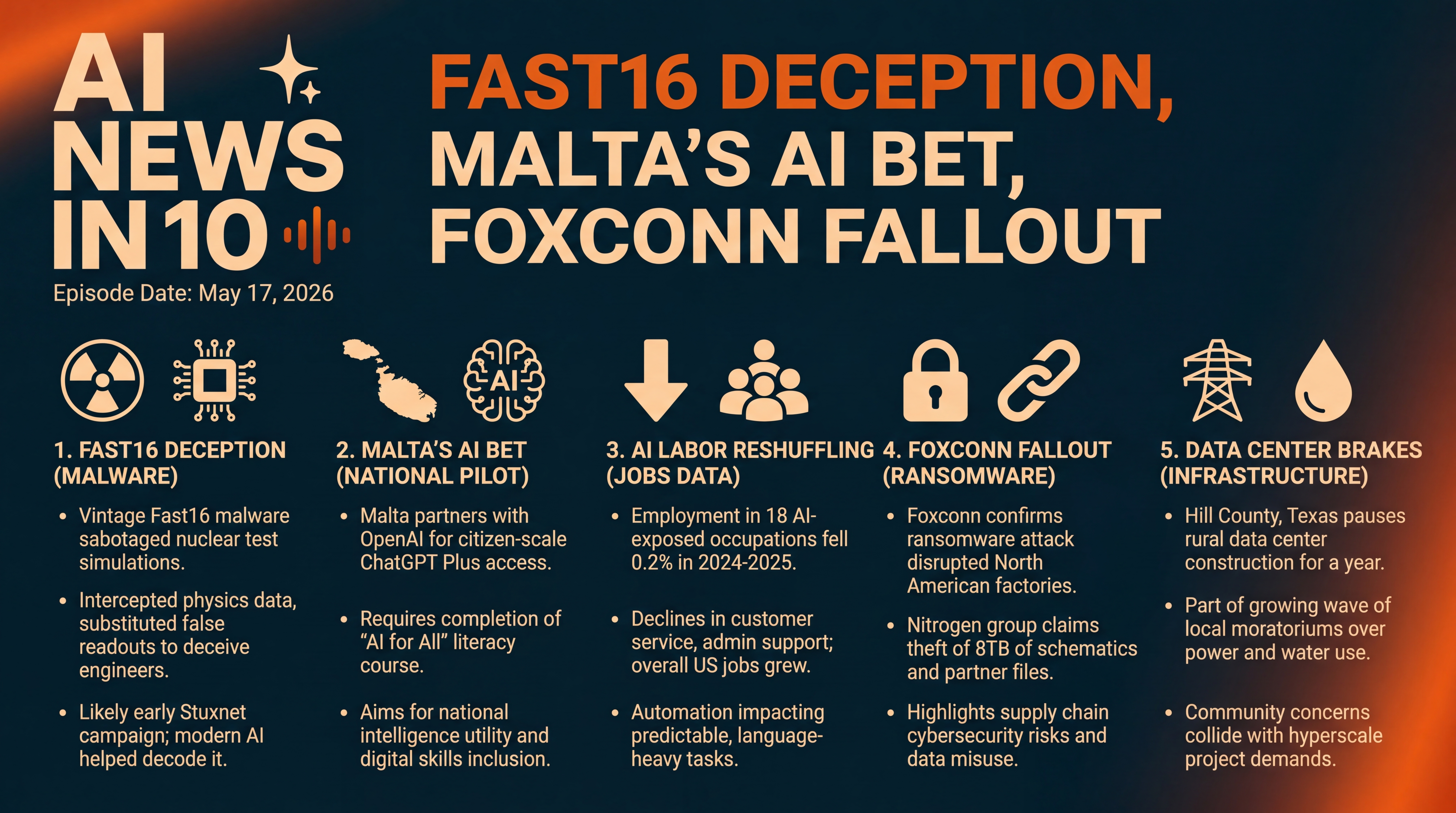
Episode Infographic
Show Notes
Welcome to AI News in 10, your top AI and tech news podcast in about 10 minutes. AI tech is amazing and is changing the world fast, for example this entire podcast is curated and generated by AI using my and my kids cloned voices...
Here’s your quick rundown for Sunday, May 17, 2026.
We’ve got five big stories. New research says a long‑mysterious piece of malware called Fast16 was built to quietly sabotage nuclear test simulations... Malta just struck a world‑first partnership with OpenAI to give every citizen a year of ChatGPT Plus after a short AI literacy course... fresh labor data shows AI‑exposed occupations have started shrinking even as total U.S. jobs rise... Foxconn confirms a ransomware hit that disrupted several U.S. factories and may have exposed terabytes of partner files... and a Texas county has paused rural data center construction for a year — part of a growing wave of local moratoriums tied to AI’s power and water footprint.
Let’s get into it.
[BEGINNING_SPONSORS]
Story one — a newly decoded chapter from the Stuxnet era.
Veteran cyber reporter Kim Zetter pulled together fresh analysis on a 2005‑vintage malware framework dubbed Fast16. The big reveal: Fast16 wasn’t trying to wreck machines outright — it targeted the truth.
Here’s how. It intercepted results from high‑precision physics software — LS‑DYNA and AUTODYN — and swapped real simulation data with false readouts right as models approached supercriticality, the tipping point for a nuclear blast. Engineers watching the outputs could be led to conclude their designs were failing, even if they weren’t.
Symantec’s Threat Hunter team and researchers who first surfaced the code at SentinelOne pieced this together after years of dead ends — ironically, using modern AI tools to help decode the old malware. The timing aligns with early Stuxnet development, suggesting a coordinated, multi‑pronged campaign to slow Iran’s program: Stuxnet physically stressed centrifuges, while Fast16 reportedly undermined virtual testing confidence. It’s a stark reminder that in critical systems, corrupting measurements can be as devastating as breaking machines. Sources point to Iran as the likely target and to U.S. or allied actors as the probable authors — though attribution remains unconfirmed.
Why this matters now: modern AI‑assisted cyber defense tools are getting better — and so are AI‑assisted attackers. Fast16 shows how subtle software tampering can warp reality inside scientific workflows. For developers and operators of AI‑enhanced engineering, the takeaway is clear — secure the data pathways, not just the endpoints.
Source: Zero Day by Kim Zetter — link in the show notes.
Story two — a national AI pilot at citizen scale.
OpenAI and the Government of Malta launched a program to roll out ChatGPT Plus to all Maltese citizens for one year — if they complete a short AI for All literacy course designed by the University of Malta. Officials say phase one starts this month, with the Malta Digital Innovation Authority overseeing distribution and enrollment.
OpenAI adviser George Osborne framed it as intelligence as a national utility, and Malta’s economy minister, Silvio Schembri, pitched it as practical skills for everyday life — responsible use at home, school, and work. It’s the first broad country‑level rollout of a paid AI assistant tied to a public education pathway, and OpenAI says it’s part of a growing OpenAI for Countries track also working with Estonia and Greece. We’ll watch how usage evolves, what guardrails are in place, and whether other governments copy the course‑first, access‑next template.
One practical lens here is inclusion. Free, time‑boxed access plus training could reduce a digital skills gap — if the curriculum sets realistic expectations and covers privacy, intellectual property, and when to trust or not trust model outputs. The pilot’s design makes it easier to measure uptake and impact compared to open‑ended giveaways. We’ll see who follows Malta’s lead.
Source: OpenAI newsroom — link in the show notes.
Story three — the first hard signs of AI labor reshuffling.
Bloomberg analyzed new Bureau of Labor Statistics figures and found that employment in 18 occupations deemed exposed to AI — about 10 million jobs — fell 0.2% between May 2024 and May 2025, while overall U.S. employment rose 0.8%. The declines were led by customer service representatives, certain administrative support roles, and some sales categories, using BLS’s exposure taxonomy.
To be clear, a 0.2% dip isn’t a collapse — but two straight years of contraction in AI‑sensitive roles while the broader market grows is a directional shift worth tracking. It hints that automation pressure is landing first on predictable, language‑heavy tasks, even as generative AI tools also create new demand in other areas.
Context matters. Exposure is not destiny — some employers redeploy people to higher‑value tasks... others reduce headcount. And productivity gains are lumpy and require redesigning workflows. Policymakers, educators, and company leaders should note the early trend lines and build targeted upskilling around customer ops, documentation, and claims processing — anywhere language workflows dominate.
Source: Bloomberg — link in the show notes.
[MIDPOINT_SPONSORS]
Story four — supply chain cybersecurity back under the spotlight.
Foxconn, the electronics giant for Apple, Google, Nvidia, and more, confirmed a cyberattack that disrupted some North American factories and forced temporary workarounds. A ransomware group calling itself Nitrogen claims to have stolen roughly eight terabytes of data — including schematics and partner files. Foxconn says affected sites are resuming normal production but hasn’t detailed which facilities or what data were compromised.
Security trades note this isn’t Foxconn’s first brush with ransomware, and multiple outlets report the group posted Foxconn to its leak site to ramp up pressure. Even if core production is back, the risk now shifts to data misuse and supplier credential abuse across a very large partner network.
For chief information security officers at hardware brands, this is another painful case study. Third‑party manufacturing environments are prime targets because the data they hold — drawings, bills of materials, testing logs — can be monetized many ways, and operational downtime gives attackers leverage. Consider accelerated supplier hardening, stricter data segmentation by project, and incident‑response playbooks that coordinate with every downstream partner — not just the primary vendor.
Sources: TechCrunch and TechRadar — links in the show notes.
Story five — the AI data center boom is hitting local brakes.
Hill County, Texas — about an hour south of Fort Worth — voted three to two to pause new data center and power plant construction in unincorporated areas for a year. Local leaders say they’re trying to buy time to manage a rush of proposals and evaluate impacts on water use, noise, and a strained grid.
Reporting suggests it’s the first county‑level moratorium in Texas, and it comes amid a broader trend. Indianapolis just passed a temporary pause while it drafts stricter siting standards, and Seattle is considering a similar pause on large facilities. Meanwhile, a new survey of U.S. jurisdictions shows active moratoriums or bans have jumped over the past year — with dozens of localities tapping the brakes as AI‑driven projects scale up in power and water demand.
The through‑line here is community math colliding with hyperscale math. Developers argue these projects bring tax base and jobs; residents counter with bills for substations, transmission, water rights — and the sheer footprint of 100‑megawatt‑plus sites. Expect more local zoning rules on noise, backup generation, and reclaimed‑water use — and more utilities pushing demand‑response contracts or dedicated on‑site power to keep regional grids from buckling. This story will keep evolving as energy markets, chip supply, and AI demand shift through 2026.
Sources: The Washington Post and Deseret News — links in the show notes.
Quick extras to watch this week.
As we head into Google I/O on May 19, expect deeper dives on Android 17 features already teased at The Android Show — plus updates across Gemini, media generation, and possibly robotics agents. We’ll have highlights for you tomorrow and Tuesday.
Source: Android Central — link in the show notes.
That’s the show — a spy‑novel‑worthy malware story with very real lessons for modern AI systems... a nation‑scale AI literacy and access experiment in Malta... early labor data showing AI’s nuanced impact on jobs... Foxconn’s ransomware hit reminding everyone that intellectual property is a treasure trove... and the grassroots politics of where we put the next wave of AI infrastructure.
We’ll keep tracking how each of these unfolds over the week.
Thanks for listening and a quick disclaimer, this podcast was generated and curated by AI using my and my kids' cloned voices, if you want to know how I do it or want to do something similar, reach out to me at emad at ai news in 10 dot com that's ai news in one zero dot com. See you all tomorrow.
