
Gemini Refresh, Deepfake Rules, Nvidia Signals
Google I/O kicks off with a day-of Gemini app refresh and an AI-heavy keynote in the spotlight. We break down new deepfake takedown rules in the U.S. and UK, OpenAI’s jury win over Elon Musk, and Nvidia’s read on China ahead of earnings.
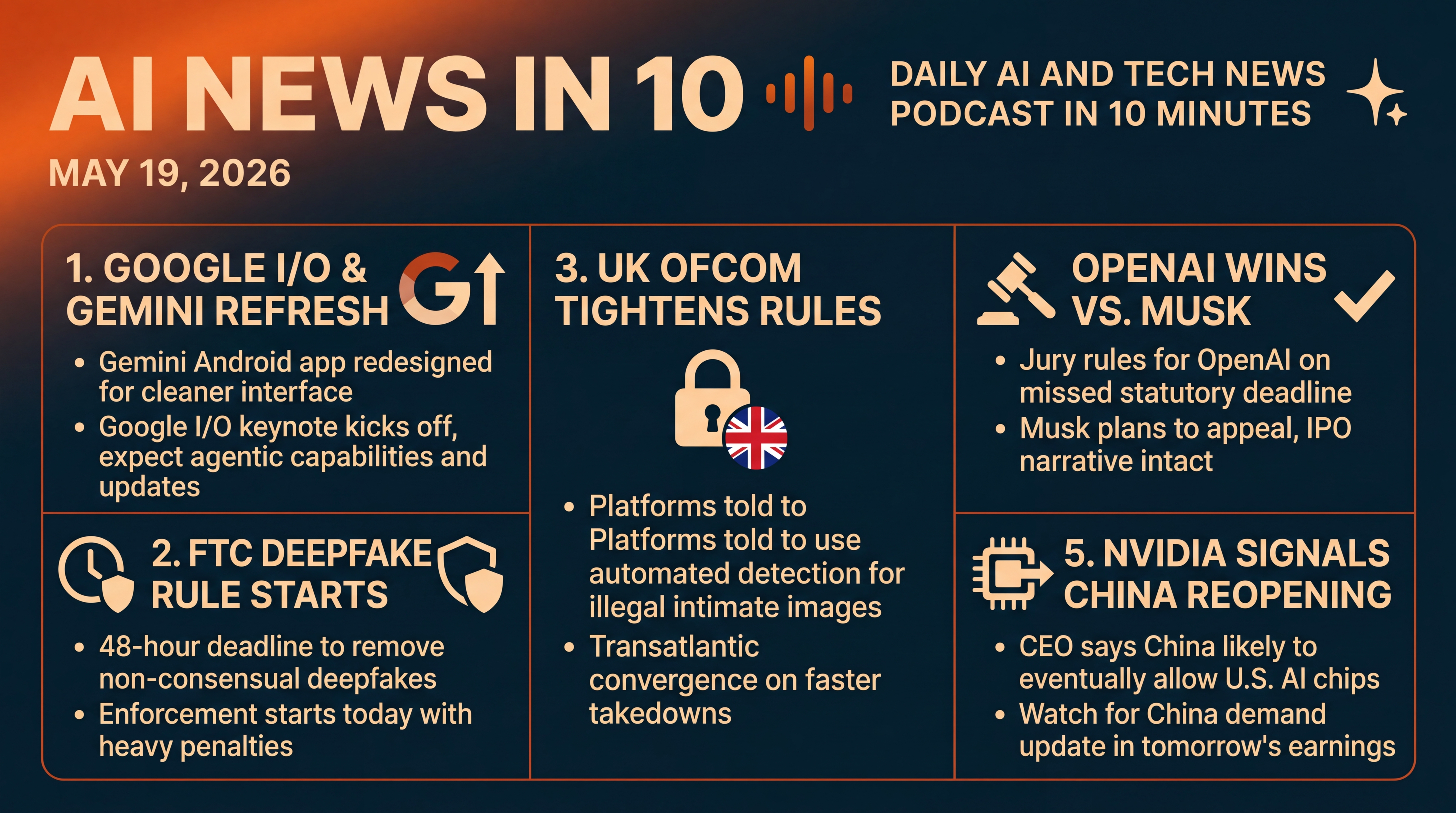
Episode Infographic
Show Notes
Welcome to AI News in 10, your top AI and tech news podcast in about 10 minutes. AI tech is amazing and is changing the world fast, for example this entire podcast is curated and generated by AI using my and my kids cloned voices...
It's Tuesday, May 19, and it's a busy day in AI and tech.
Google I/O kicks off today in Mountain View — 10 a.m. Pacific, 1 p.m. Eastern — and Google isn't waiting for the keynote to make moves.
Overnight, users started seeing a sweeping redesign of the Gemini app on Android, with a cleaner interface that mirrors recent iOS changes. We'll get into what's new, what to watch on stage, and why this matters for everyday users.
We'll also zoom out to crucial policy shifts... In the U.S., the FTC's Take It Down Act enforcement starts today, forcing platforms to remove non-consensual intimate images — including AI-generated deepfakes — within 48 hours, with real penalties for noncompliance. Across the Atlantic, UK regulator Ofcom has strengthened its codes too, telling major platforms to use proven detection tech to curb illegal intimate images.
In legal news, OpenAI just won a jury verdict against Elon Musk — heading off a potentially bruising defeat as the company presses toward an IPO. Musk says he plans to appeal.
And we'll close with the global supply chain angle: Nvidia's Jensen Huang says he expects China will ultimately reopen to U.S. AI chips — a signal to watch ahead of Nvidia's earnings tomorrow.
[BEGINNING_SPONSORS]
Story 1 — Google I/O kicks off as Gemini gets a day-of refresh
If you're following along live, the I/O keynote starts at 10 a.m. Pacific — expect an AI-heavy program plus Android 17 updates. Google watchers have already spotted one tangible shift: a redesigned Gemini app rolling out on Android that cleans up navigation and brings the look and feel closer to the recent iOS revamp.
Reports describe a more streamlined home experience and faster handoffs to common tasks — think less screen clutter, quicker answers, and a clearer path into creation and device controls. It's an early, concrete change you can feel before a single on-stage demo today.
Two things to keep an eye on during the keynote and developer sessions: first, how deeply Gemini's agentic capabilities are embedded across Android and Chrome; second, whether Google clarifies timing for broader rollouts beyond Pixels and a handful of partner devices.
Hardware talk is always possible at I/O, but the near-term user impact is usually about software shipping windows, betas, and a steady cadence of app updates — this morning's Gemini refresh is a good example.
If you're watching from home, plenty of outlets are running live blogs and hands-on posts as the news lands.
Story 2 — The FTC's 48-hour deepfake takedown rule starts today
Today is the enforcement start date for the Take It Down Act's core online-platform obligations. The headline requirement is simple: if a victim submits a valid request to remove a non-consensual intimate image — including an AI-generated deepfake — the platform must take it down, and remove identical copies, within 48 hours.
The Federal Trade Commission has sent letters to more than a dozen major tech companies reminding them of the law's scope and penalties. Civil penalties can reach more than $53,000 per violation.
The FTC also published guidance spelling out what covered platforms need to have in place: a clear notice process for victims, timely removal, and tracking numbers to coordinate with victims and law enforcement. This moves the response to non-consensual intimate imagery — and deepfakes — from best effort to a federal obligation... with a clock attached.
A practical implication for product teams: the 48-hour window pressures trust and safety operations to automate triage and hash matching wherever possible. Cybersecurity reporters note that the FTC intends vigorous enforcement and has previewed how it will police compliance starting May 19.
If you run a forum, messaging app, or media-sharing service, today may be your first real-world test of that service level agreement.
Story 3 — UK Ofcom tightens the screws on illegal intimate images
The UK isn't standing still either. Ofcom says it is strengthening its Illegal Content Codes under the Online Safety framework by recommending that certain platforms expand their use of automated detection — specifically hash matching — to stem the spread of illegal intimate images posted without consent, including explicit deepfakes.
It's framed as a targeted addition reflecting the urgent need to better protect women and girls online. Combined with the U.S. FTC timeline, we're seeing a transatlantic convergence on faster takedown plus proactive detection for the worst abuses of generative media.
For global platforms, aligning U.S. 48-hour takedowns with UK detection expectations will be the operational challenge of the week.
[MIDPOINT_SPONSORS]
Story 4 — OpenAI wins a jury verdict against Elon Musk
In Oakland, a federal jury ruled for OpenAI in Elon Musk's lawsuit, finding that he waited too long to file — missing a statutory deadline. The verdict came after a three-week trial and less than two hours of deliberation.
Musk says he will appeal. The case aired unflattering testimony about OpenAI leadership, but for now the company avoids a costly loss that could have complicated its path to a public offering. OpenAI is widely seen as on track for one of the largest IPOs in history — so today's outcome keeps that narrative intact, even as the legal and reputational skirmishing continues.
From an industry standpoint, the dispute was less about model weights and more about corporate structure and mission drift — nonprofit ideals versus the realities of scaling frontier AI. Regardless of where you land, the verdict reduces near-term legal uncertainty for a company that's central to cloud and enterprise AI roadmaps worldwide.
Story 5 — Nvidia's CEO: China is likely to reopen to U.S. AI chips
After joining the U.S. delegation to Beijing last week, Nvidia CEO Jensen Huang told Bloomberg Television he expects China will eventually allow imports of U.S. AI chips. He didn't claim a done deal — he framed it as a question of how much protection China wants for local champions versus market openness.
Recall that Washington cleared Nvidia's H200 shipments to a set of Chinese firms late last year, but Chinese authorities have so far held up purchases. Over time, Huang says, the market will open.
Nvidia reports earnings tomorrow, and any update on China demand will be closely parsed. For hyperscalers and OEMs navigating multisourcing between U.S. and Chinese silicon, that's a potential swing factor.
Quick recap
Google I/O goes live today, and Google primed the pump with a visible Gemini app overhaul on Android.
In policy, the FTC's 48-hour deepfake takedown rule starts now, while UK Ofcom is pushing platforms to use automated detection for illegal intimate images.
In the courts, OpenAI beat Elon Musk in a jury verdict — appeal ahead, IPO narrative intact.
And on the supply side, Nvidia's CEO is signaling that China could eventually reopen to U.S. AI chips... a storyline to watch as earnings hit tomorrow.
Thanks for listening and a quick disclaimer, this podcast was generated and curated by AI using my and my kids' cloned voices, if you want to know how I do it or want to do something similar, reach out to me at emad at ai news in 10 dot com that's ai news in one zero dot com. See you all tomorrow.
