
AI Scale Shock: Rockets, Chips, and Cities
SpaceX’s IPO reveals a colossal Anthropic compute deal as Nvidia posts a historic quarter and Washington readies an AI cybersecurity directive. Plus: AMD’s $10B Taiwan bet and Denver’s pause on new data centers.
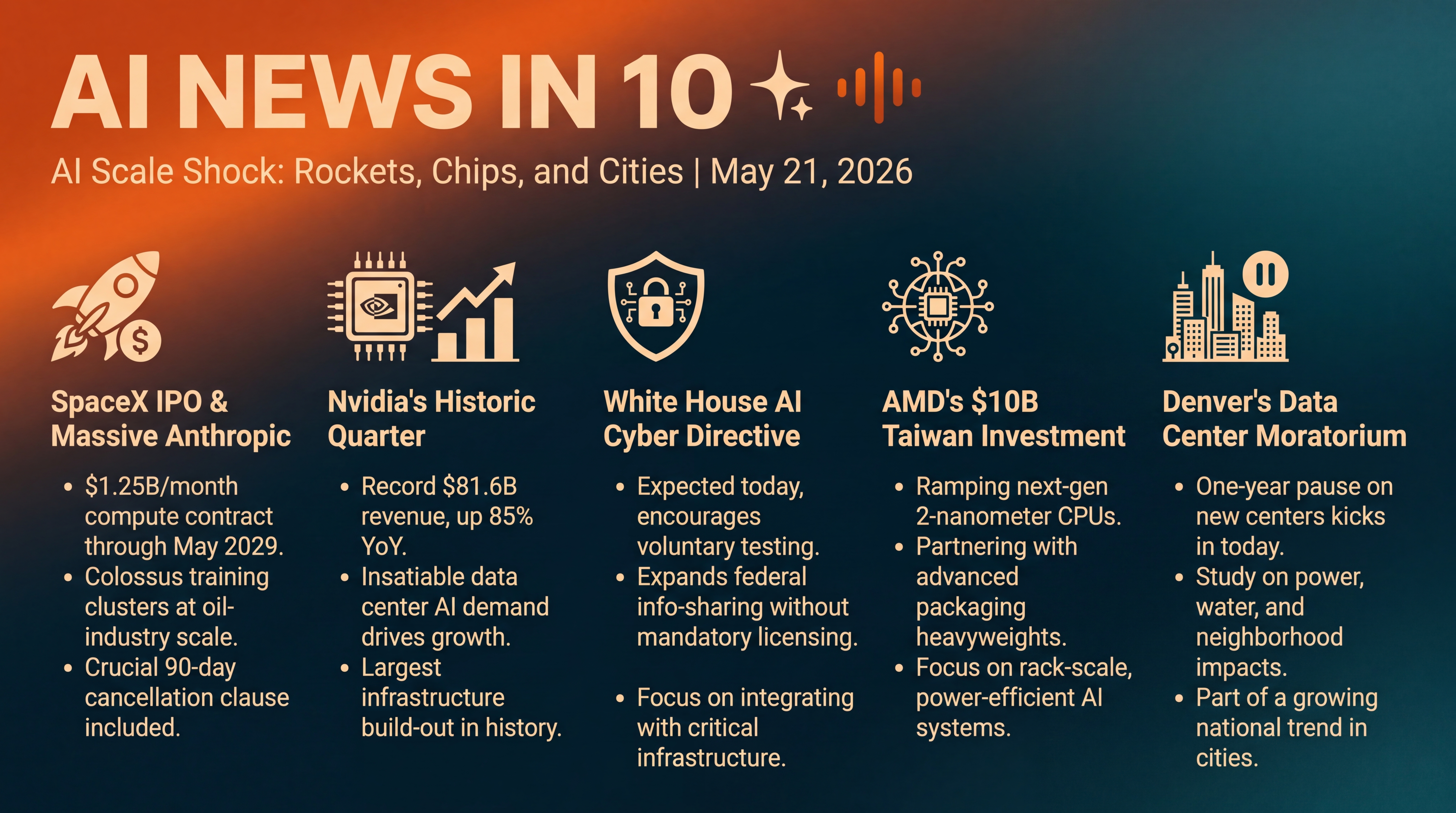
Episode Infographic
Show Notes
Welcome to AI News in 10, your top AI and tech news podcast in about 10 minutes. AI tech is amazing and is changing the world fast, for example this entire podcast is curated and generated by AI using my and my kids cloned voices...
It's Thursday, May 21, 2026.
Here's what's new in AI and tech... and it's a big one.
SpaceX's long-awaited IPO filing lands with jaw-dropping AI numbers — including a compute contract with Anthropic that rewrites the scale of AI infrastructure.
Nvidia follows with an earnings report so large it's hard to keep straight — more than $80 billion in a single quarter, driven by data center AI.
In Washington, the White House is expected to sign an AI cybersecurity directive today, aiming to harden networks without imposing full-blown licensing.
On the chip front, AMD says it will invest over $10 billion in Taiwan's AI supply chain — and it's beginning to ramp its next-gen 2-nanometer CPUs.
And at the city level, Denver's one-year moratorium on new data centers kicks in today amid growing pushback over water, power, and neighborhood impacts.
Buckle up...
[BEGINNING_SPONSORS]
Let's start with SpaceX — and the scale of AI it just telegraphed to public markets.
The company's IPO prospectus reveals that Anthropic, maker of the Claude models, has agreed to pay SpaceX $1.25 billion per month for access to its giant AI training clusters — Colossus and Colossus Two — through May 2029.
At that pace, it's roughly $15 billion a year.
The filing also shows SpaceX booked $18.67 billion in revenue last year... but a $4.9 billion net loss, reflecting massive AI and infrastructure bets.
There's a crucial nuance: either party can cancel the Anthropic deal with 90 days' notice — so investors shouldn't count every dollar as guaranteed revenue.
And the AI segment lost about $2.5 billion from operations in the March quarter on $818 million in revenue — underscoring how fast SpaceX is spending to stand up compute.
If you felt the ground shift under AI infrastructure... you're not imagining it.
What does that mean in plain English?
For model makers, compute has become a monthly utility bill — at oil-industry scale.
For SpaceX, AI is now a third pillar alongside launch and Starlink... but it's still deeply unprofitable as the company races to build capacity.
For Anthropic, the contract locks in a staggering amount of training headroom — while preserving flexibility via that 90-day exit clause.
Second story... Nvidia.
The chip giant's first fiscal quarter numbers are in, and they are, frankly, historic. Nvidia posted $81.6 billion in revenue, up 85% year over year — a blowout that topped Wall Street expectations and reflected insatiable demand from cloud and enterprise customers building AI factories.
Jensen Huang's framing — that the world is in the midst of the largest infrastructure build-out in history to power AI — may sound hyperbolic... but the math is starting to bear it out.
One note for context: even breathtaking quarters can produce mixed market reactions when expectations are sky-high. Despite the beat, investors are parsing guidance and supply dynamics — but the demand signal for training and inference silicon remains strong heading into the second half.
Third, policy — and it could land today.
President Trump is poised to sign an AI cybersecurity directive as soon as Thursday, May 21, expanding federal information-sharing and encouraging voluntary government testing of frontier AI systems — but stopping short of mandatory model approvals.
The plan would bring AI companies into existing cybersecurity programs without imposing a licensing regime.
Translation: this is more let's test together and share intel — not you must get federal permission before you release a model.
Watch for how agencies implement the testing piece — that's where the rubber meets the road for vendors integrating with critical infrastructure owners and operators.
[MIDPOINT_SPONSORS]
Number four... AMD just put a big marker down in Asia's AI supply chain.
The company will invest more than $10 billion across Taiwan's AI sector — partnering with advanced packaging and testing heavyweight ASE and its unit SPIL — and ramping its Venice CPUs built on TSMC's cutting-edge 2-nanometer process.
It also named server makers like Wiwynn, Wistron, and Inventec among its manufacturing partners as it works to deliver rack-scale, power-efficient AI systems.
AMD says production of Venice is beginning to ramp now — an important milestone as hyperscalers eye heterogeneous clusters that pair GPUs with ever-beefier CPUs for agentic and memory-heavy workloads.
Why it matters: most of the AI spotlight has shone on accelerators, but CPUs are becoming far more central in modern AI pipelines — from orchestrating multi-agent workflows to serving retrieval and memory systems.
AMD's investment signals an intent to compete not just at the chip level, but at the full system and supply-chain level in Taiwan — ground zero for advanced packaging and back-end assembly that can make or break AI delivery schedules.
And fifth, a local policy story with national echoes.
Denver's one-year moratorium on new data centers takes effect today, May 21. The pause won't affect already-permitted projects, and the city will study power, water, and neighborhood impacts during the freeze.
Denver becomes the latest in a fast-growing list of U.S. communities pressing pause as AI's energy and land demands collide with local planning. Dozens of jurisdictions now have active moratoriums.
This is a microcosm of a bigger trend: cities want AI-driven growth — but not at any cost to grids, water supplies, or quality of life.
Stepping back... the through-line today is scale — and the frictions it creates.
SpaceX's filing shows AI compute contracting at a scale we've never seen, yet those contracts can still be fragile. Nvidia's quarter shows unrelenting demand for AI hardware. Washington is trying to harden the nation's cyber posture without choking innovation. AMD is placing billion-dollar bets to ensure supply keeps up. And cities like Denver are insisting that the build-out respect local constraints.
That's AI in 2026: physics, politics, power bills... and profits, all pulling at each other.
That's it for today.
Quick recap: SpaceX's IPO filing spotlights a $1.25 billion-per-month Anthropic deal and big AI losses; Nvidia's revenue hits $81.6 billion for the quarter; the White House is expected to sign an AI cybersecurity directive today; AMD commits over $10 billion to Taiwan's AI ecosystem and starts ramping 2-nanometer CPUs; and Denver's moratorium on new data centers kicks in.
See you tomorrow for the next turn of the wheel.
Thanks for listening and a quick disclaimer, this podcast was generated and curated by AI using my and my kids' cloned voices, if you want to know how I do it or want to do something similar, reach out to me at emad at ai news in 10 dot com that's ai news in one zero dot com. See you all tomorrow.
