
From Fan-Made Covers to Data Center Rush
Spotify and UMG greenlight licensed AI music while Lenovo and AMD signal a still red-hot infrastructure cycle. We also unpack DeepSeek's AGI-first raise and why Europe's AI stocks are quietly leading.
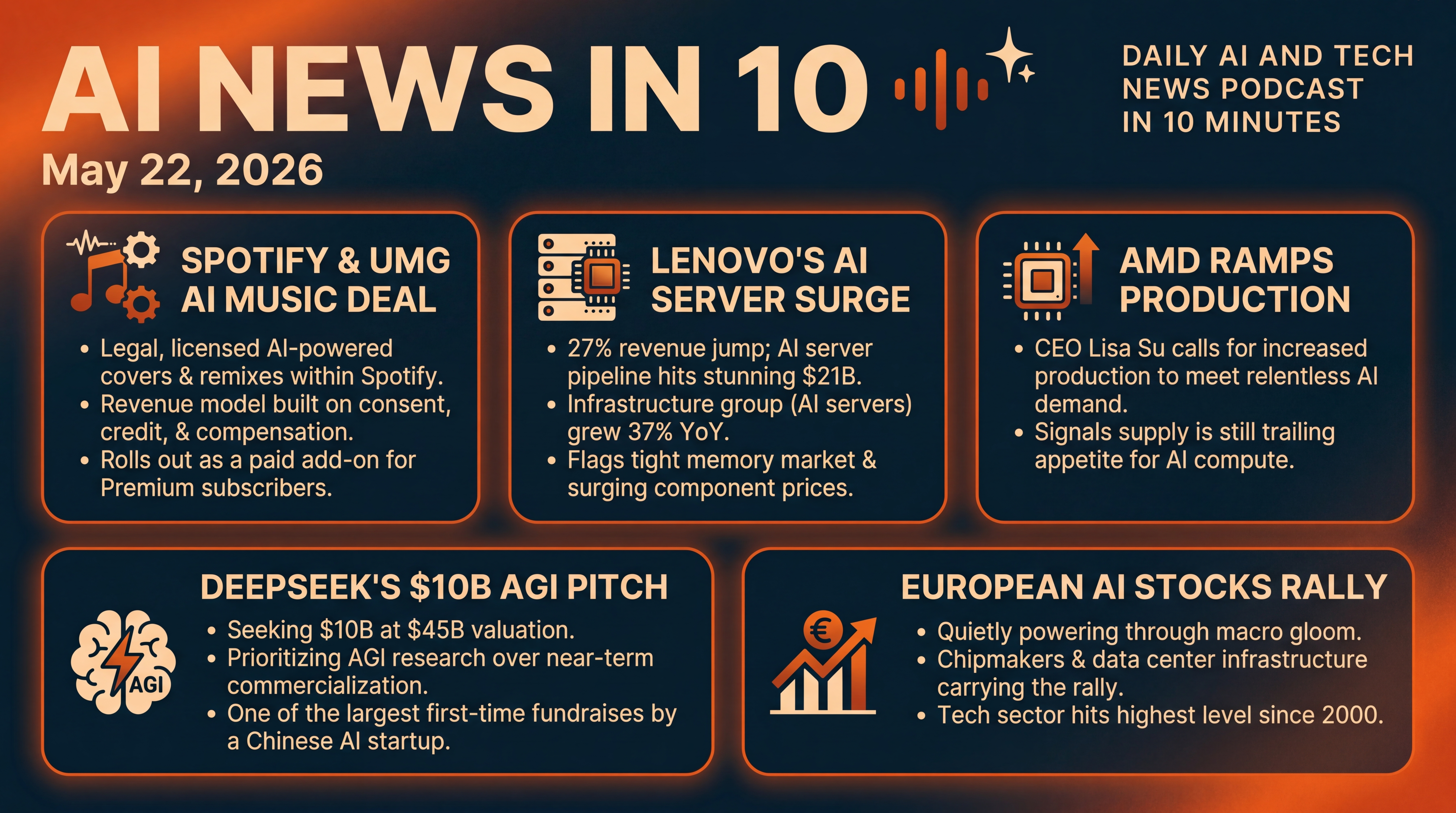
Episode Infographic
Show Notes
Welcome to AI News in 10, your top AI and tech news podcast in about 10 minutes. AI tech is amazing and is changing the world fast, for example this entire podcast is curated and generated by AI using my and my kids cloned voices...
It's Friday, May 22, 2026... and we've got a packed rundown.
First, Spotify inks a landmark deal with Universal Music Group that lets fans legally create AI-powered covers and remixes — yes, inside Spotify — with a revenue model built on consent, credit, and compensation.
Then, Lenovo surprises with a 27 percent revenue jump and says its AI server order pipeline is now a stunning 21 billion dollars. We'll pair that with AMD CEO Lisa Su's call in Taipei to crank up production to meet relentless AI demand.
In venture land, China's DeepSeek is reportedly seeking around 10 billion dollars at a 45 billion dollar valuation, and telling investors it's prioritizing AGI over near-term commercialization.
And we'll close with the big picture: European AI stocks are quietly powering through macro gloom, with chipmakers and data center infrastructure names carrying the rally.
[BEGINNING_SPONSORS]
Story one: Spotify just put a real business wrapper around AI music.
The company and Universal Music Group have new recorded-music and publishing agreements that will let Premium subscribers use a forthcoming in-app tool to generate licensed covers and remixes from participating artists. The model is built on consent, credit, and compensation — artists and songwriters share in the value, and the tool rolls out as a paid add-on to Premium.
Spotify's Alex Norstrom frames it as solving hard problems for music, and UMG's Lucian Grainge calls it an artist-centric initiative to deepen fan relationships and open new revenue streams. It's a shift from the whack-a-mole era of unlicensed AI tracks toward something the industry can live with — and profit from. Spotify even highlighted the tool during investor presentations, signaling this is not a lab experiment... it's a strategic product bet.
What should you watch next? Pricing and guardrails. It's a paid add-on, but adoption will hinge on ease of use, protections for artist reputation, and how payouts are calculated. Also watch whether rival labels or platforms follow with similar opt-in, paid frameworks for AI remixes. If they do, we could see a platform-level detente around AI music this year.
Story two: Lenovo's results landed with a thud — in a good way.
Revenue for the March quarter rose 27 percent to 21.6 billion dollars, beating estimates, and net profit jumped 479 percent to 521 million dollars. Shares popped about 15 percent in Hong Kong.
The driver is not just a PC recovery. Lenovo says its AI server order pipeline has swelled to 21 billion dollars, and its infrastructure group — home to AI servers — grew revenue 37 percent year over year. The company also flagged a tight memory market, noting heavy shortages and surging prices tied to AI data center demand that is soaking up components. Industry data shows Lenovo outpacing the broader PC market in shipments, too.
Big takeaway: the AI PC story helps... but the real torque is coming from back-of-house infrastructure.
Why it matters beyond Lenovo: when an OEM's AI server pipeline hits tens of billions, it feeds a loop through the whole stack — HBM memory, power systems, optics, and cooling. Expect continued pressure on component pricing and long-lead contracts as hyperscalers and large enterprises lock in capacity.
Story three dovetails right into supply.
AMD CEO Lisa Su said in Taipei that the company is asking partners to ramp production to meet robust AI demand. AMD relies on TSMC for advanced nodes, and the ask signals that — even after the recent wave of capacity announcements — supply is still trailing the appetite for AI compute. The comment was brief but pointed, and it comes as system makers race to bring AMD's latest accelerators into data centers alongside Nvidia's, while major cloud customers diversify their compute options.
If you're looking for catalysts, watch how quickly ODMs and board partners can translate wafer capacity into shipped systems in the back half of 2026.
[MIDPOINT_SPONSORS]
Story four: DeepSeek's pitch to investors is bold and very 2026 — go big on AGI, even if that means de-emphasizing near-term commercialization.
Reporting indicates DeepSeek is seeking roughly 70 billion yuan — about 10 billion dollars — at a valuation around 45 billion dollars, with prospective backers that include China's National Artificial Intelligence Industry Investment Fund alongside Tencent and others. Leadership has told investors they plan to keep open-sourcing models while pushing toward AGI. If the round comes together at those terms, it would be one of the largest first-time fundraises by a Chinese AI startup, and a signal that massive private capital still wants to underwrite long-horizon breakthrough bets — especially outside the United States.
For enterprises evaluating vendors, a question emerges: are you buying road-tested tools for the next 12 months... or underwriting an AGI moonshot?
One implication is competitive differentiation. DeepSeek's low-cost models stirred the market last year; staying open source while chasing AGI could keep community momentum high and cost pressure on proprietary rivals. But the tradeoff is execution risk — customers often want reliability SLAs, guardrails, and real support footprints that AGI-first research orgs still have to build. Watch whether DeepSeek pairs this raise with service partnerships, distribution deals, or dedicated enterprise teams to bridge that gap.
Story five zooms out to a markets lens.
European AI-exposed stocks are quietly pushing higher even as the region wrestles with an energy shock. Research shared with Reuters points to two baskets of European AI names — one centered on semiconductors like ASML, STMicroelectronics, and Infineon, and another around AI infrastructure players such as Schneider Electric and Prysmian — up roughly 20 to 22 percent since early April. The broader Stoxx 600 has slipped since the outbreak of the war involving Iran, but European tech just hit its highest level since 2000. Strategists argue that capex in defense, energy security, and AI infrastructure is keeping secular growth intact, with valuations still below U.S. peers.
If you're a founder or operator, the read-through is simple: Europe's AI value chain — lithography, power, cabling, and data center hardware — remains investable, and could hold up even if broader European indices lag.
Quick lightning round to connect the dots.
First, the Spotify and UMG deal hints at a template for other IP-heavy industries — news, sports, even short film clips — to experiment with licensed fan creations, not just takedowns. If that expands, AI creation could shift from the gray market to green-lighted channels faster than many expected.
Second, Lenovo's pipeline and AMD's production nudge both reinforce what the chip equipment and memory suppliers have been saying for months: AI infrastructure demand is still outpacing supply, and that extends beyond GPUs into memory, interconnects, and power.
Third, if DeepSeek lands its raise, the open versus closed debate will keep playing out across multiple geographies and funding ecosystems — and that competition should benefit users through faster iteration and better pricing.
That wraps it for today. We covered a legal on-ramp for fan-made AI music at Spotify, Lenovo's breakout quarter and its monster AI server pipeline, AMD's call to ramp production, DeepSeek's AGI-first funding ambitions, and why European AI stocks are quietly leading.
Net-net... AI is moving from splashy demos to hard infrastructure and — increasingly — to licensed consumer creativity. We'll keep tracking how quickly the supply chain, the regulators, and the rights holders adapt.
Thanks for listening and a quick disclaimer, this podcast was generated and curated by AI using my and my kids' cloned voices, if you want to know how I do it or want to do something similar, reach out to me at emad at ai news in 10 dot com that's ai news in one zero dot com. See you all tomorrow.
