Policy Whiplash, Deepfake Checks, and Cannes Clash
A shelved White House AI order, rising hallucinations in research and law, and OpenAI’s new image verifier. Plus, Alabama’s high-wage skills pipeline and Cannes’ culture clash over generative tools.
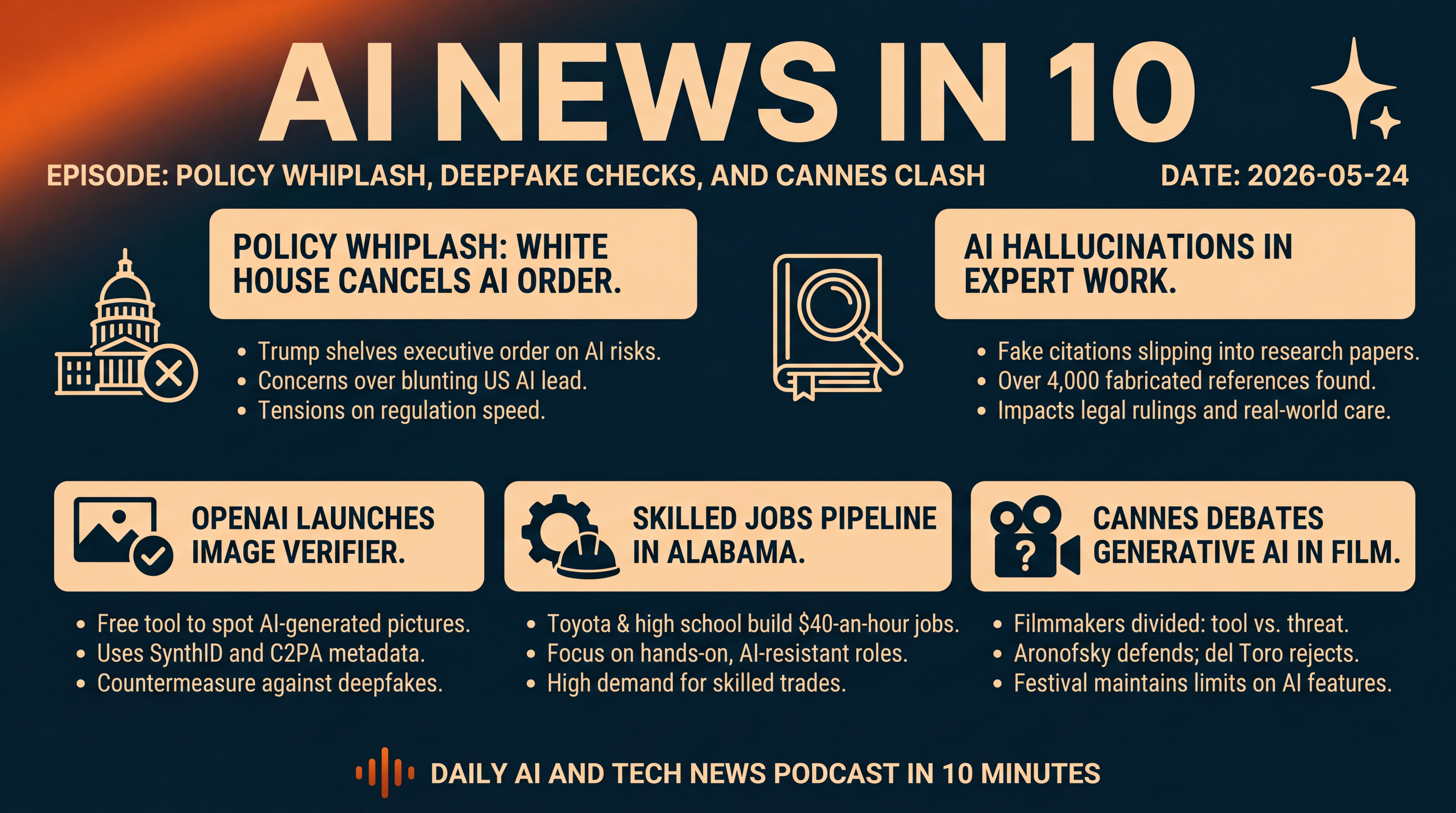
Episode Infographic
Show Notes
Welcome to AI News in 10, your top AI and tech news podcast in about 10 minutes. AI tech is amazing and is changing the world fast, for example this entire podcast is curated and generated by AI using my and my kids cloned voices...
It’s Sunday, May 24, 2026. Here’s your quick tour of what matters in AI and tech today.
We’ve got a policy curveball from Washington — the White House called off a planned AI executive order over concerns it could blunt America’s lead… Fallout and next steps are already in motion.
We’ll look at a sobering Fortune analysis on AI hallucinations quietly entering expert work — from research papers to legal rulings.
Then, a practical counterpunch: OpenAI just released a free image verification tool to help spot AI-generated pictures.
After the break, we’ll head to Alabama, where Toyota and a public high school are building a pipeline for $40-an-hour jobs that AI can’t easily automate.
And we’ll close on culture: Cannes is in an all-out debate about generative AI — Darren Aronofsky says it expands the toolbox, while Guillermo del Toro says he’d rather die than use it.
Let’s get into it.
[BEGINNING_SPONSORS]
Story one — the executive order that wasn’t.
President Trump shelved a planned AI and cybersecurity executive order just hours before a White House signing ceremony, saying he didn’t want to do anything that could “get in the way” of America’s AI lead.
Reporting from the Associated Press says the order would have created a framework for the government to vet national security risks of frontier AI systems before release. Instead, the event was pulled — reflecting internal tensions over how far, and how fast, to regulate. Source: BusinessMirror, citing Associated Press.
There are still parallel moves happening. Earlier this month, the Commerce Department said it had agreements with Google, Microsoft, and Elon Musk’s xAI to provide early access to powerful models for government review — building on earlier voluntary commitments by OpenAI and Anthropic. That announcement later disappeared from the department’s site.
Treasury Secretary Scott Bessent, along with Fed Chair Jerome Powell, also convened Wall Street CEOs to warn about cybersecurity risks from Anthropic’s Claude Mythos model. Today’s pause underscores a political balancing act: many voters worry about AI’s impact on jobs and security… while the administration emphasizes keeping a competitive edge.
Story two — the cost of getting facts almost right.
A Fortune investigation highlights how AI hallucinations are infiltrating expert work… and even entering the permanent record.
Columbia nursing professor Maxim Topaz set out to quantify the problem after an AI tool quietly slipped a fake citation into a scientific paper. In a Lancet-linked audit of nearly 2.5 million biomedical papers and 97 million citations on PubMed Central, his team found more than 4,000 fabricated references across almost 3,000 papers — with the rate of fakes rising sharply since 2024. In early 2026, about one in 277 papers had at least one nonexistent reference.
That’s not just an academic headache. Once a bad citation enters the chain — from trial to review to guideline — it can influence real-world care.
The piece also notes growing evidence of AI-assisted errors in journalism and law, including a catalog of more than 1,400 legal decisions citing inaccurate AI-generated content.
The takeaway: the tools aren’t the villain, but unverified AI outputs are slipping into places where verification used to be assumed. Source: Fortune.
Story three — a countermeasure you can use today.
OpenAI rolled out a free image verification tool to help people check whether an image was generated by its systems. The checker looks for two provenance signals: SynthID from Google DeepMind — designed to persist through common edits and screenshots — and C2PA metadata, the open content-provenance standard.
There are caveats. For now, it’s scoped to visuals produced via ChatGPT, the OpenAI API, or Codex — so images made by other models may go undetected. Still, pairing watermark-style signals with metadata makes provenance checks more resilient than either method alone. OpenAI says it plans to expand coverage over time.
It’s a concrete, consumer-facing step in a month when governments and platforms are grappling with deepfakes. Source: The Indian Express.
[MIDPOINT_SPONSORS]
Story four — where the jobs are… and will be.
Fortune spotlights Huntsville’s new, $40 million Huntsville Center for Technology, where about 700 students split time between traditional classes and industry-standard training. An “Inditech” program backed by Toyota Alabama — seeded with $1 million from the automaker’s endowment — prepares students for industrial maintenance and advanced manufacturing roles that local employers can’t fill fast enough.
Instructors say graduates can realistically earn more than $40 an hour with a two-year degree and early experience. Nationally, the U.S. could need about 1.9 million manufacturing workers by 2033 — and the AI data center buildout is intensifying demand for electricians, construction pros, and other skilled trades.
The thesis is blunt: as AI trims certain white-collar roles, communities that invest in hands-on, high-wage, hard-to-automate skills can pull forward economic mobility… and keep critical industries humming. Source: Fortune.
Story five — Cannes vs. the machines.
On the Croisette, filmmakers and studio leaders spent the festival arguing over generative AI’s place in cinema. Darren Aronofsky — launching projects through his new studio, Primordial Soup — defended AI as an additive tool, not a replacement, pointing to practical benefits like safely simulating sensitive shots. Google DeepMind and others are also collaborating on creative experiments.
Steven Soderbergh said about 10 percent of his Lennon documentary’s imagery uses AI as “thematic surrealism,” akin to other kinds of VFX — with an obligation to disclose how it was done. On the other side, Guillermo del Toro declared he would “rather die” than use AI in his films. Seth Rogen dismissed AI-assisted screenwriting. And the festival is maintaining limits on primarily AI-generated features in competition.
Whether you see it as new paint or a counterfeit brush, the debate is no longer theoretical — it’s on stage, in dailies, and increasingly in contracts. Source: The Guardian.
Quick context check as we wrap.
In Washington, today’s executive order reversal shows how divided even pro-innovation circles are on pre-release model testing. In the trenches, Fortune’s data suggests verification has to move upstream — journals, courts, and newsrooms can’t assume accuracy just because a draft reads clean.
On the tools front, OpenAI’s verifier won’t stop every deepfake… but it’s a start you can try right now. Meanwhile, schools and employers are retooling pathways into the essential economy that AI still can’t automate — even as the culture wrestles with what authenticity means in the age of generative everything.
That’s your AI News in 10 for May 24. New guardrails on pause, verification on the rise, skills in demand, and a creative world arguing in public about what to embrace… and what to resist. See you tomorrow.
Thanks for listening and a quick disclaimer, this podcast was generated and curated by AI using my and my kids' cloned voices, if you want to know how I do it or want to do something similar, reach out to me at emad at ai news in 10 dot com that's ai news in one zero dot com. See you all tomorrow.
