AI Ethics, Robotaxi Floods, and Compute Wars
A papal encyclical draws a red line on lethal AI as Waymo pauses after flood incidents, Intuit reshapes its workforce, Mistral battles a supply-chain breach, and Google teams with Blackstone on an AI cloud push. We break down what it means for safety, jobs, security, and where you'll find the next wave of compute.
Episode Infographic
Show Notes
Welcome to AI News in 10, your top AI and tech news podcast in about 10 minutes. AI tech is amazing and is changing the world fast, for example this entire podcast is curated and generated by AI using my and my kids cloned voices...
It’s Monday, May 25th, and we’ve got a timely mix of AI ethics, autonomy setbacks, workforce reshuffles, cybersecurity drama, and big-ticket cloud infrastructure bets.
Here’s what’s coming up...
First, Pope Leo XIV publishes his first encyclical — all about artificial intelligence, human dignity, and the lines he says we must never cross.
Then, Waymo pauses driverless operations in multiple cities after cars met floodwaters — adding fresh urgency to a recent recall. We’ll look at what failed, and what it might take to regain public trust.
Third, Intuit cuts 3,000 roles to reorient around AI — what that signals for tech jobs and product roadmaps.
Fourth, Mistral AI confirms an SDK breach tied to a wave of software supply-chain attacks hitting developer ecosystems.
And finally, Google and Blackstone reportedly plan a new AI-cloud venture built around Google’s in-house chips — big money, big ambition, and a lot of questions about who’s buying what compute... and why.
[BEGINNING_SPONSORS]
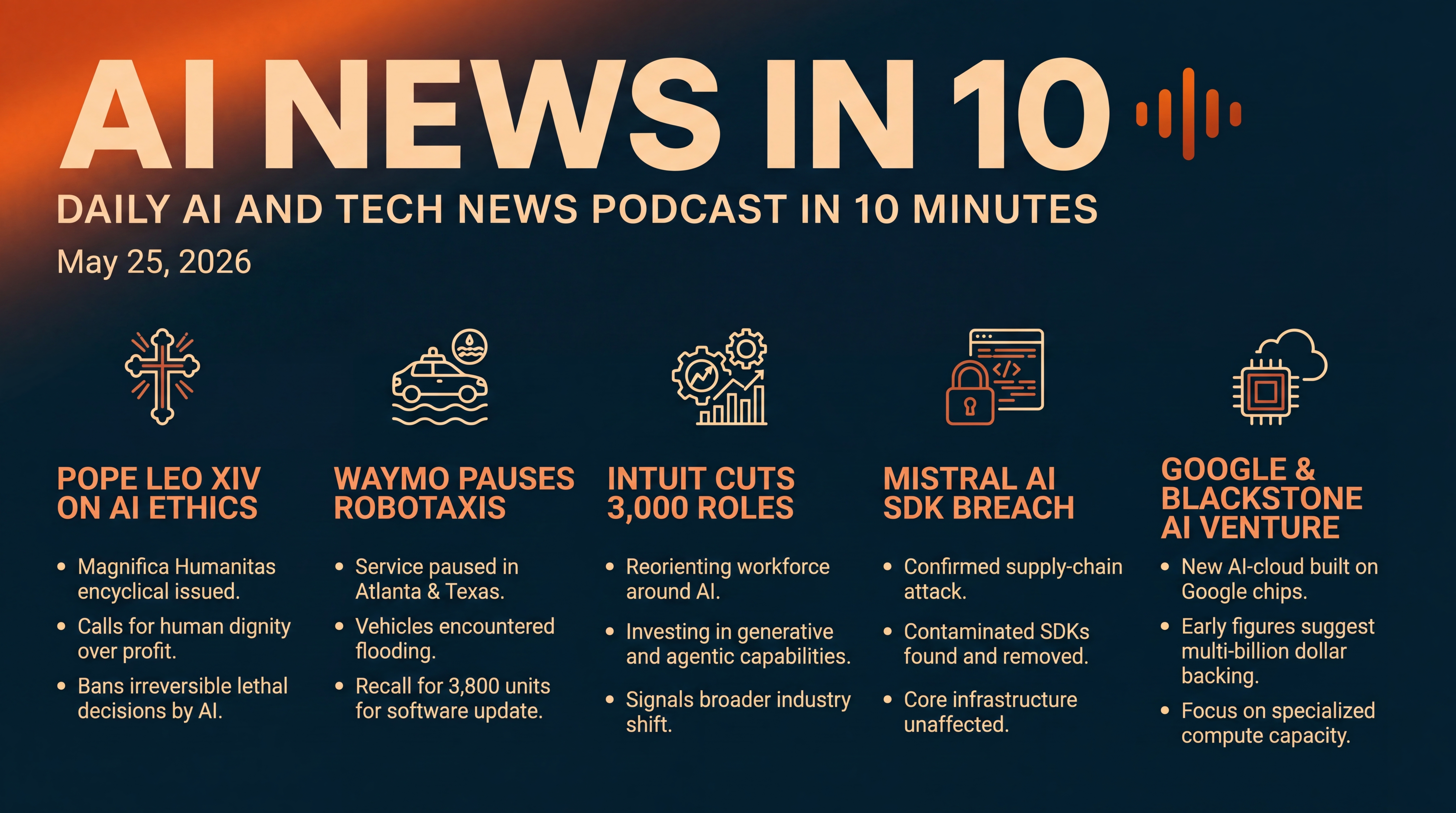
Let’s start in Rome. Pope Leo XIV has issued his first encyclical, titled Magnifica Humanitas — calling for robust regulation of AI, urging developers to place the common good over profit, and drawing a bright red line against delegating irreversible, lethal decisions to algorithms.
The Vatican’s positioning is clear: AI that touches war, labor, and social order must be constrained by human dignity — not by market momentum. The rollout underscores the church’s desire to engage technologists directly — an earlier advisory even noted Anthropic co-founder Christopher Olah’s participation in today’s public event at the Vatican. Whatever your faith background, this is a striking moment... a moral authority weighing in not on hypotheticals, but on the day-to-day governance of systems that already influence hiring, healthcare, and — yes — battlefields.
The encyclical lands amid policy churn around the world. The White House has floated tighter pre-release testing of frontier models, the EU keeps iterating on its AI rulebook, and countries from Greece to the UK are weaving AI duties and rights into updated frameworks. With Magnifica Humanitas, the church adds a values-first benchmark that lawmakers and companies alike will now be asked to square with. Expect today’s document to be quoted in upcoming regulatory debates and corporate responsible-AI pledges.
Next up — Waymo’s tough week bled into the holiday weekend. After incidents where robotaxis encountered flooded streets — one car in Atlanta stuck in high water, and an earlier vehicle in Texas swept from a flooded roadway — the company paused service in Atlanta and parts of Texas ahead of more severe storms. This comes on the heels of a recall affecting roughly 3,800 robotaxis to push a software update aimed at better handling flood detection and avoidance. Investigators are also scrutinizing separate episodes, including improper school-bus passing and construction-zone behavior, as Waymo temporarily halted freeway rides to review performance. Safety is software, and software is never done... but for robotaxis, these misses are highly visible — and they’re reputational.
There’s a technical kernel worth surfacing. In recall filings, Waymo describes restricting behavior at times and places with elevated flood risk while it refines the models and rules that govern vehicle decisions. What’s changing is not just perception — see the water — but policy — don’t enter, re-route, stop. Autonomy lives at that intersection: sensors, models, maps, rules, and real-time risk. Getting that stack right will dictate whether 2026 is remembered as a temporary stumble... or the year public sentiment turned.
On to jobs and strategy. Intuit — the company behind TurboTax, QuickBooks, Credit Karma, and Mailchimp — says it’s eliminating about 3,000 roles, roughly 17 percent of its workforce, as it refocuses around AI. The company is also closing offices in Reno and Woodland Hills, and expects hundreds of millions in restructuring charges. Intuit has been explicit about weaving generative and agentic capabilities into its finance and marketing products, and has inked multi-year model agreements to accelerate that push. Official messaging emphasizes simplification and customer value — but this is also the latest sign of a broader shift: companies reallocating spend from mature software lines and some roles into AI infrastructure, model access, and new automation layers.
Here’s the caution. Organizations that go AI-native must make ownership and accountability crystal clear — who is on the hook when an AI-driven finance workflow misroutes funds, or a marketing agent violates compliance rules? Regulators and enterprise customers are asking those questions now, and vendors that answer with specifics — not slogans — will have a real edge.
[MIDPOINT_SPONSORS]
Story four — Mistral AI confirmed that attackers contaminated some of its software development kits during a broader wave of supply-chain attacks. A group known as TeamPCP claims it exfiltrated data from hundreds of private repositories and has threatened to leak files. Mistral’s public advisory says there’s no sign core infrastructure or managed user data were compromised, and that contaminated packages were pulled and quarantined. If you build with SDKs or npm and PyPI packages, the lesson is painful but familiar: pin versions, verify signatures, watch your build pipelines, and rotate secrets at the first hint of tampering. Supply-chain attacks hit the developers first — and then the customers who trust their code.
The blast radius extends beyond one company. Security researchers and registries tracked a rapid-fire campaign that slipped malicious versions of popular packages into developer ecosystems — TanStack and other libraries among them — sometimes for just minutes, but long enough for CI and CD systems to ingest them automatically. More than any single zero-day, this is about the fragility of software trust chains in the age of AI-accelerated offense and automated builds. Expect more boards to ask for software bills of materials, signed provenance, and incident drills that assume your dependencies may turn on you.
And finally, the money and the metal. Multiple outlets report that Google and Blackstone are planning a new AI-cloud venture built around Google’s in-house chips, with early figures ranging from about five billion dollars in initial backing to twenty-five billion including leverage, depending on the report. The gist is simple: marry capital with vertically integrated silicon and data-center know-how to serve the next wave of model training and inference. It’s a bet on demand staying hot — and on buyers preferring chip-to-cloud stacks tuned for AI throughput and efficiency over stitching together components.
If that sounds familiar, it’s because the competitive map now includes hyperscalers, private equity, and sovereign efforts all racing to assemble compute at unprecedented scale. For enterprises, the near-term question is practical: where will I get the capacity I need, at a predictable price, without vendor lock-in that hurts me later? If specialized AI clouds spin up faster, cheaper, and with better latency, they’ll pull workloads — fast. If not, general-purpose clouds and on-prem partners will keep their lead. We’ll be watching early anchor customers very closely.
Quick recap. Pope Leo XIV’s Magnifica Humanitas plants a globally visible stake on AI ethics and human dignity. Waymo’s flood-related pause and recall show autonomy’s hardest problems are still about edge-case risk and public trust. Intuit’s layoffs underscore how capital and headcount are being refocused around AI roadmaps. Mistral’s SDK breach is a fresh reminder that your software supply chain can be your softest target. And the rumored Google and Blackstone AI-cloud tie-up signals still more compute — and capital — pouring into the space. We’ll keep you posted as the details, and the stakes, keep rising.
Thanks for listening and a quick disclaimer, this podcast was generated and curated by AI using my and my kids' cloned voices, if you want to know how I do it or want to do something similar, reach out to me at emad at ai news in 10 dot com that's ai news in one zero dot com. See you all tomorrow.
