Jobs Not Doomed, DeepSeek Price Shock, Meta Forum
Sam Altman tempers job-loss fears as DeepSeek slashes API prices, Meta pilots a Reddit-style Groups app, Congress probes prediction markets, and UCLA launches a 125 million dollar semiconductor hub. We break down how these moves reshape costs, compliance, and the AI hardware pipeline — and what to watch next.
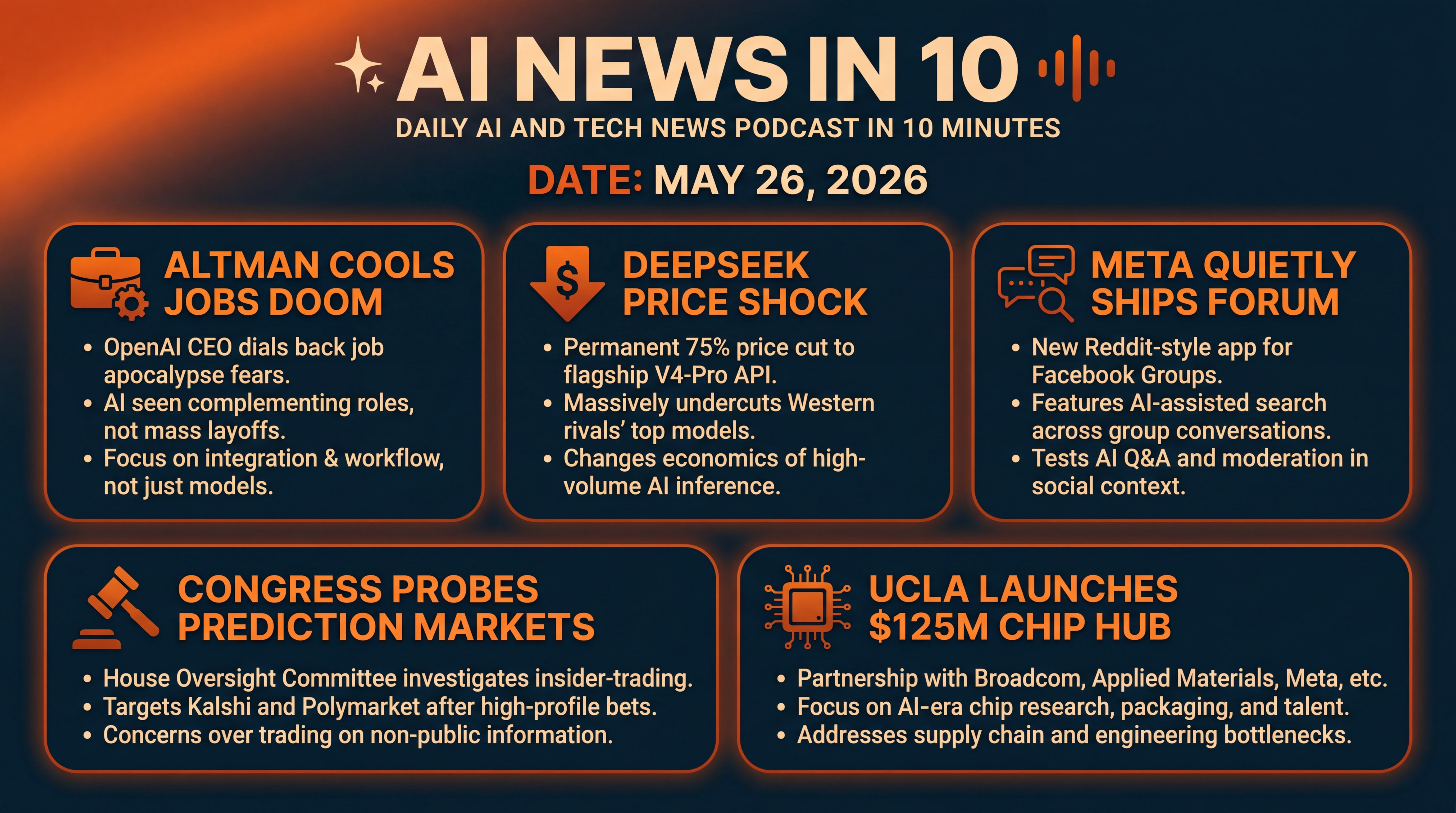
Episode Infographic
Show Notes
Welcome to AI News in 10, your top AI and tech news podcast in about 10 minutes. AI tech is amazing and is changing the world fast, for example this entire podcast is curated and generated by AI using my and my kids cloned voices...
It’s Tuesday, May 26, 2026... here’s what’s new in AI and tech.
Sam Altman is dialing back fears of a jobs apocalypse, China’s DeepSeek just made a price move that could jolt AI economics, Meta is quietly shipping a Reddit-style Groups app infused with AI, Congress is turning up the heat on prediction markets after insider-trading scares, and UCLA is launching a 125 million dollar semiconductor hub backed by some of the industry’s biggest names.
Let’s get into it.
[BEGINNING_SPONSORS]
Story one — Sam Altman is putting distance between today’s AI and the doom-and-gloom about jobs.
In an interview in Sydney, the OpenAI CEO said rapid AI progress hasn’t produced the white-collar layoffs he once feared, and that a global jobs apocalypse now looks unlikely. He put it plainly: “I’m delighted to be wrong about this.” Entry-level office roles haven’t vanished at the pace many predicted. Multiple outlets amplified the Reuters interview today — a reminder of how central the jobs question is in the AI debate.
What’s the takeaway? We’re in a more measured phase — adoption is real... but organizational change, reskilling, and process redesign take longer than the hype cycles admit. For workers, AI is complementing many roles — research, drafting, data analysis — rather than replacing them outright. For companies, it’s a nudge to focus on integration quality and workflow fit, not just shiny model benchmarks.
Story two — a pricing earthquake from DeepSeek.
The Chinese AI lab has made permanent a 75% cut to its flagship V4-Pro API pricing — turning what began as a time-boxed promotion into the new normal. For developers, that’s not just a headline discount; it can materially change the unit economics of high-volume inference, batch processing, and agentic workloads. Reports peg the new rate at roughly three yuan per million tokens for the flagship tier — massively undercutting Western rivals’ top-shelf models.
If you’re watching the broader AI price war, this cements a two-front squeeze: compression on premium models — and ongoing drops in caching rates that can lower costs by an order of magnitude for certain patterns. Expect procurement teams to revisit cost models this week, and rival labs to feel fresh pressure on margins.
Why it matters is simple math. If a startup can run an agent that queries tools, reads docs, and proposes actions for pennies per million tokens — instead of dimes or dollars — the break-even for automating routine knowledge work shifts... fast. That could unlock more AI-everywhere pilots in support, ops, and finance — especially where latency tolerances are flexible. It also raises a familiar question about sustainability: how long can anyone sell premium tokens if a “good enough” competitor costs a fraction?
Story three — Meta quietly ships Forum.
Meta launched a new app called Forum — a Reddit-like experience built for Facebook Groups, with a couple of notable AI helpers. Forum centralizes group conversations into a dedicated feed and adds two features: Ask, an AI tool that can pull responses across your groups; and an admin assistant to help moderators manage communities. You log in with Facebook credentials — so it’s not truly anonymous — but you can adopt usernames, while admins still see real identities behind the scenes. Meta framed it as a public test: “We test lots of new products publicly to see what people find interesting and useful.” It’s a small launch... but strategically interesting, bringing AI-assisted Q&A into the social-search arena where Reddit, Google, and Quora have been experimenting.
If Forum gains traction, watch for two ripple effects. First, search: as users ask real-people questions and the AI corrals answers across groups, Meta edges into a space where AI summaries meet community trust. Second, moderation: an AI admin assistant at the group level hints at a broader toolkit for safety and civility that could spill over into Facebook proper — if it works.
[MIDPOINT_SPONSORS]
Story four — Washington turns up the heat on prediction markets.
The House Oversight Committee has opened a probe into insider-trading risks at Kalshi and Polymarket, sending letters to both CEOs requesting documents on identity verification, geographic restrictions, and how they detect suspicious trading. The investigation follows high-profile bets placed just ahead of major policy or security events. Chairman James Comer says the pattern suggests Congress may need to act if platforms can’t deter trading on non-public information. The letters set a document-production clock — reportedly by June fifth — so we could see a flurry of compliance updates or new guardrails in the next 10 days.
This isn’t just a crypto policy story. It’s about how real-time markets on information intersect with national security and market integrity — at a moment when AI tools can mine, correlate, and act on signals faster than humans. If you’re a data vendor, a quant shop, or a newsroom using AI agents... the rules around material non-public information on event markets could soon look a lot more like securities compliance — KYC, surveillance, and audit logs included.
Story five — new money and muscle for the chip pipeline.
UCLA’s Samueli School of Engineering is launching a 125 million dollar Semiconductor Hub with founding partners Broadcom, Applied Materials, GlobalFoundries, Meta, and Synopsys. The five-year industry-academia program aims to advance AI-era chip research — think advanced packaging, design tools, and materials — while training the next wave of semiconductor engineers. In practical terms, it’s a bet that the bottlenecks in AI are shifting from just getting more GPUs to optimizing every layer — from materials and packaging to EDA tools and fab workflows. With Broadcom and Applied on equipment and packaging, GlobalFoundries on manufacturing, Synopsys on design automation, and Meta representing hyperscaler demand, the partnership spans much of the stack. Expect collaborative testbeds, curriculum pipelines, and faster handoffs from lab prototypes to pilot runs.
Two quick context notes. First, this dovetails with a broader U.S. push to onshore and de-risk parts of the semiconductor supply chain — especially around AI accelerators and photonics. Second, it acknowledges the talent squeeze. If you’re a student or mid-career engineer, the signal is clear: packaging, advanced substrates, EDA, and verification are hot growth fields... not just the chips themselves.
Let’s wrap.
Today, May 26: Altman cools the jobs-doom narrative, DeepSeek redraws the price map for cutting-edge models, Meta tests AI-assisted social search inside Groups, Congress probes whether prediction markets are leaking the future, and UCLA’s new hub aims to widen the AI chip pipeline. The through-line is momentum with maturing expectations — costs falling, tools getting more targeted, and institutions from Capitol Hill to campuses racing to catch up. We’ll keep watching how those pieces click together... tomorrow.
Thanks for listening and a quick disclaimer, this podcast was generated and curated by AI using my and my kids' cloned voices, if you want to know how I do it or want to do something similar, reach out to me at emad at ai news in 10 dot com that's ai news in one zero dot com. See you all tomorrow.
