Governance to Gadgets: AI’s Next Moves
From OpenAI’s new governance framework to Meta’s rumored AI pendant and Snowflake’s real agent-driven revenue, we break down the week’s biggest shifts. Plus, an Nvidia Arm CPU leak and Verizon’s latest data show software exploits now outpace stolen credentials.
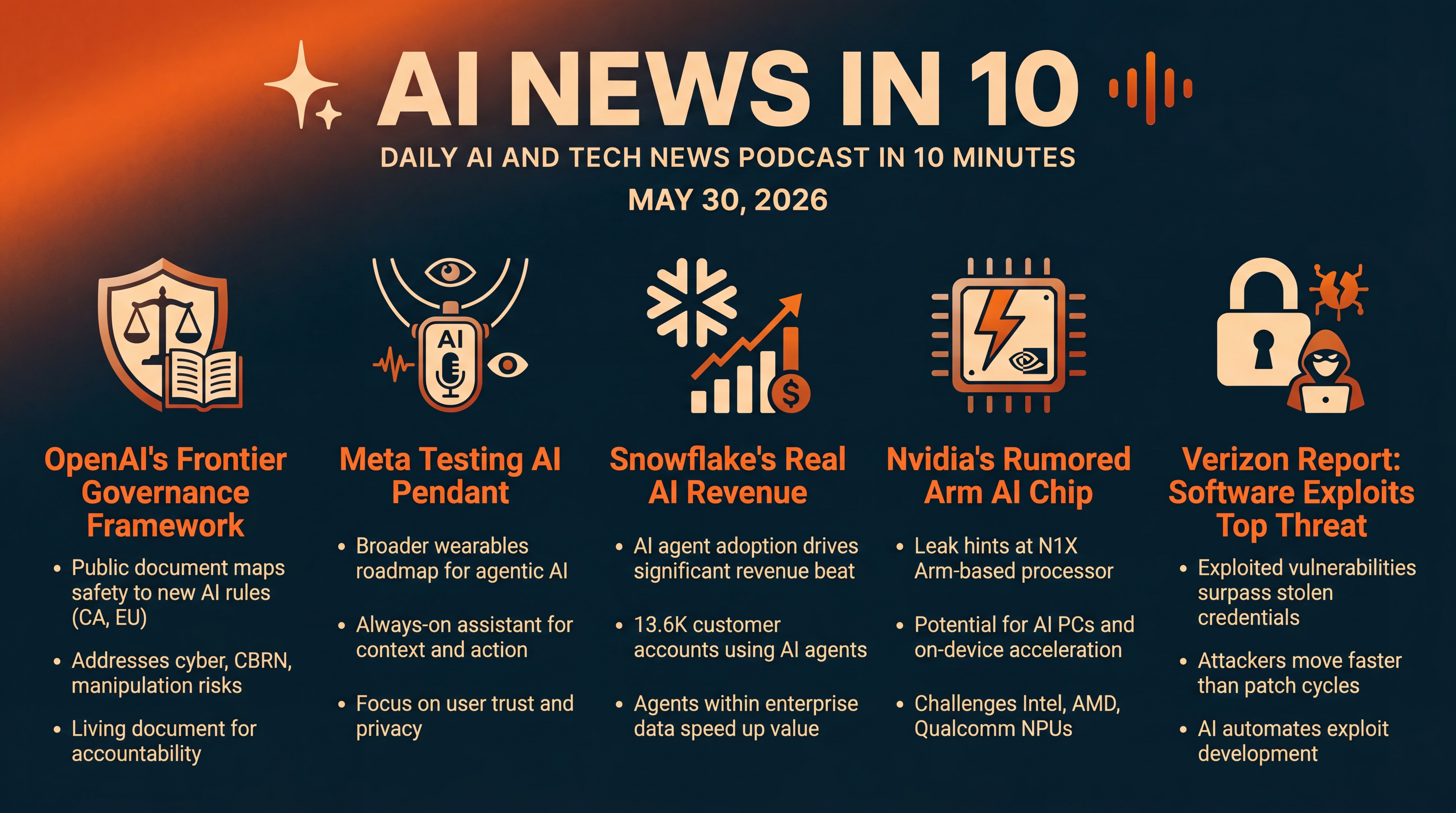
Episode Infographic
Show Notes
Welcome to AI News in 10, your top AI and tech news podcast in about 10 minutes. AI tech is amazing and is changing the world fast, for example this entire podcast is curated and generated by AI using my and my kids cloned voices...
It’s Saturday, May 30, 2026, and here’s what’s new in AI and tech. We’ve got OpenAI formalizing how it plans to meet fast-emerging AI rules... Meta sketching its next round of wearable hardware... Snowflake surprising Wall Street with real AI adoption... a juicy leak hinting at Nvidia’s Arm-based N1X chip... and a sober cybersecurity report from Verizon saying software exploits — not passwords — are now the top way attackers get in. Sources today include OpenAI, Reuters, The Information, PC Gamer, and Verizon.
[BEGINNING_SPONSORS]
Let’s kick off with OpenAI moving first on governance.
On Thursday, May 28, OpenAI published a Frontier Governance Framework — a public document that maps its safety and security practices to fast-evolving rules like California’s Transparency in Frontier AI Act and the EU’s emerging code of practice for general-purpose AI. The framework spotlights four big risk buckets: cyber offense; CBRN — that’s chemical, biological, radiological, and nuclear; manipulation; and loss of control. It also lays out commitments around model reporting, incident response, and input from external experts.
OpenAI is framing this as a living document that will update as capabilities and laws mature — layered on top of its internal Preparedness Framework. That matters because regulators from Sacramento to Brussels want more than pledges — they want auditable processes.
Why it matters — it’s the clearest public handshake so far between a frontier lab’s internal safety playbook and concrete obligations lawmakers are putting on the table. If other labs follow with comparable disclosures, we’ll finally get apples-to-apples visibility into how leading systems are evaluated, what thresholds trigger extra safeguards, and how incident learnings feed back into deployment. It also signals that — even without a sweeping U.S. federal AI law — state and transatlantic rules are already shaping how top models ship. Sources: OpenAI and CIO Dive.
Next up — Meta’s hardware bets aren’t stopping at glasses.
Reuters, citing The Information, reports that Meta plans to test an AI pendant next year as part of a broader wearables-for-work and everyday-assistant roadmap. The concept fits the industry’s push toward agentic AI — always-on helpers that can see and hear context, then act on your behalf. It also lines up with Meta’s budget shift toward compute and AI — Bloomberg recently reported the company is implementing around eight thousand job cuts to refocus spend.
If the pendant ships, expect it to lean on Meta’s progress in on-device inference and its massive messaging footprint for voice and tasking — with privacy and data governance squarely in the spotlight.
What to watch — Meta has to prove this isn’t another novelty wearable. The prize is hands-free, ambient agents that schedule, summarize, shop, and triage messages without you pulling out a phone. The risk is user trust — persistent microphones and cameras demand clear controls, local processing where possible, and visible, simple off-switches. If Meta nails those, a pendant could complement its Ray-Ban smart glasses as a lower-friction, lower-cost entry into AI wearables. Sources: Reuters and Android Central.
Third — real revenue tied to AI, not just slideware.
On Wednesday, May 27, Snowflake said adoption of its AI products helped it beat guidance and raise its full-year product revenue outlook to roughly five point eight four billion dollars. The company reported thirteen thousand six hundred customer accounts using its AI agents — up from nine thousand one hundred last quarter — spanning tools like an AI coding agent and agents that query data within Snowflake and connected apps. Investors liked it — shares jumped more than thirty percent after hours.
The takeaway — AI agents that live where enterprise data already resides have a much shorter path to value. If Snowflake keeps shipping guardrailed agents that respect data governance, lineage, and cost controls, it positions itself as an AI application substrate — not only a warehouse. Expect rivals to make similar moves — bringing agents into the lakehouse — along with tighter integration with retrieval-augmented generation and domain-tuned models. Source: The Information.
[MIDPOINT_SPONSORS]
Fourth — a notable chip leak as the PC industry braces for Computex.
PC Gamer spotted references to Nvidia’s still-unannounced N1X Arm-based processor on a Lenovo login page. Details are sparse, but the naming lines up with rumors that Nvidia has been preparing Arm CPUs for AI PCs and light inference. If the N1 series shows up in laptops, it could mark Nvidia’s most direct foray into client compute silicon in years — pairing local AI acceleration with cloud handoffs and bringing its software stack closer to everyday machines. Treat it as a credible breadcrumb... but still a leak. Official specs, process nodes, and timelines remain unknown. Source: PC Gamer.
Why it matters — the AI PC story so far has hinged on NPUs from Intel, AMD, and Qualcomm. An Nvidia Arm CPU family — paired with CUDA-adjacent tooling and model runtimes — could scramble that map, give OEMs a fourth option, and push more on-device AI. It would also dovetail with Nvidia’s strategy to own as much of the AI stack as possible — from data center to desk. Source: PC Gamer.
And fifth — your cybersecurity wake-up call heading into summer.
Verizon’s 2026 Data Breach Investigations Report finds that exploited software vulnerabilities have, for the first time in nineteen years, overtaken stolen credentials as the top initial access vector. Thirty-one percent of confirmed breaches started with a software flaw. Verizon analyzed more than thirty-one thousand incidents across one hundred forty-five countries, including over twenty-two thousand confirmed breaches. Translation: attackers are moving faster than patch cycles — helped, in part, by AI tooling that automates exploit development and scanning. Sources: Verizon and TechRadar Pro.
What you can do — even on a small team. Reduce your internet-facing attack surface, prioritize patching based on exploitability — not just severity — and continuously validate controls. The report suggests the remediation speed limit for human-centered change processes is real — meaning you need compensating controls like web app firewalls tuned to known-exploited paths, rapid rollback plans, and frequent exercises. If AI is shrinking the window from disclosure to weaponization, your job is to shrink the window from detection to mitigation. Sources: Verizon DBIR, SC Media, and TechTarget.
Quick recap before we go.
OpenAI put a public governance wrapper around its safety work, signaling how big labs will meet new rules. Meta is reportedly cooking up an AI pendant as it doubles down on wearables and agentic assistants. Snowflake showed that AI agents can drive real spend — not just curiosity. Nvidia’s rumored N1X Arm chip hints at an AI PC shakeup. And Verizon’s DBIR says patch your software — because exploited vulnerabilities, not stolen passwords, are now the main door in.
Sources today: OpenAI, Reuters, The Information, PC Gamer, and Verizon.
Thanks for listening and a quick disclaimer, this podcast was generated and curated by AI using my and my kids' cloned voices, if you want to know how I do it or want to do something similar, reach out to me at emad at ai news in 10 dot com that's ai news in one zero dot com. See you all tomorrow.
