AI PCs Arrive, Data Centers Face Heat
Nvidia and Microsoft prepare AI-first Windows PCs as data center battles heat up nationwide. Plus: Cisco Live’s AI networking push, LA transit hack attribution to Iran, and SK hynix’s plan to cool HBM for faster AI.
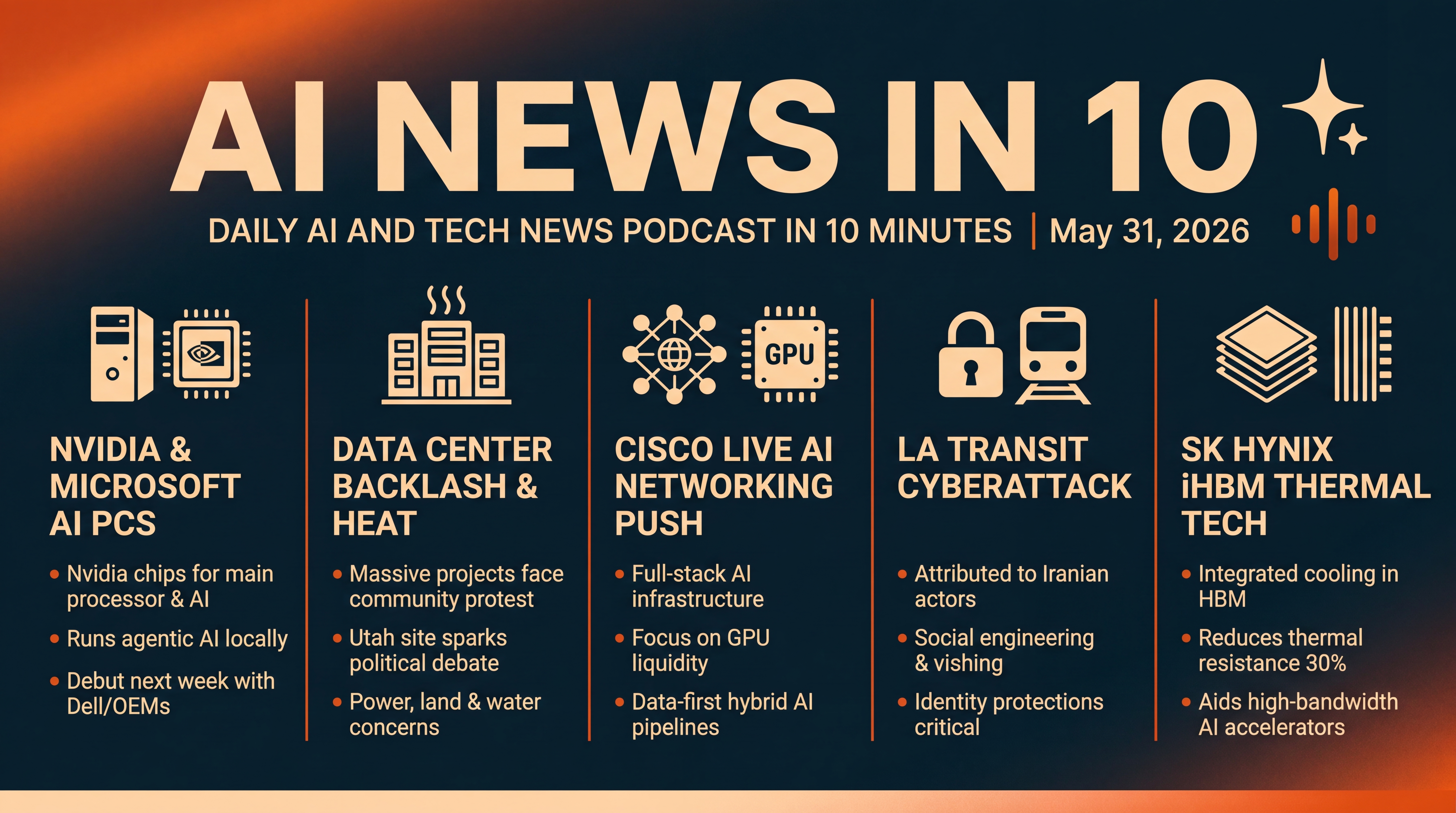
Episode Infographic
Show Notes
Welcome to AI News in 10, your top AI and tech news podcast in about 10 minutes. AI tech is amazing and is changing the world fast, for example this entire podcast is curated and generated by AI using my and my kids cloned voices...
It’s Sunday, May 31, 2026. Here’s what’s shaping the AI and tech landscape today. Nvidia and Microsoft are poised to unveil the first Windows PCs powered by Nvidia chips — not just for graphics, but as the main processor. Communities across the U.S. are battling the AI data center boom, and a high-profile Utah project is now at the center of a debate over alleged foreign propaganda. Cisco Live kicks off in Las Vegas with a full-stack AI networking push, including a new approach to GPU liquidity. We’ve also got fresh attribution in a cyberattack that hit Los Angeles transit. And on the hardware front, SK hynix is trying to cool the hottest part of AI — literally — with a new thermal architecture for high-bandwidth memory. Let’s get into it...
[BEGINNING_SPONSORS]
Story one — Nvidia and Microsoft’s new era of PC is days away
Nvidia’s long-awaited move into PC processors is about to be official. Axios reports the first Windows machines running Nvidia’s own chips — not just its GPUs — will debut next week, with Microsoft and OEMs like Dell expected to join the launch at Computex in Taiwan and at Microsoft’s Build event in San Francisco.
Nvidia’s been teasing a new era of the PC, and Windows leadership has hinted this isn’t just a fresh OS build — it’s a shift toward PCs that can run agentic AI locally. That matters for cost, privacy, and latency, especially as autonomous agents rack up cloud bills. Axios also says Microsoft is readying software so those agents can work on-device, not only in the cloud.
Why it matters... Microsoft’s first AI PC wave stumbled after delays and Recall-related security concerns, but Nvidia brings serious AI credibility with developers and enterprises. If Nvidia’s PC silicon delivers competitive performance and battery life — and if Microsoft’s tools make agent workflows easy to run locally — Windows on Arm, and Arm-like designs, could finally hit escape velocity. Intel and AMD would face fresh competition on their home turf. It’s also a strategic hedge: run more AI at the edge, ease cloud pressure, and give businesses better cost control.
Story two — The data center backlash turns political, and personal
A Washington Post investigation describes how protests against massive AI data centers — including a proposed site in northwest Utah spanning forty thousand acres with a projected price tag of one hundred billion dollars — have drawn claims from Shark Tank investor Kevin O’Leary and Interior Secretary Doug Burgum that foreign propaganda, particularly from China, is inflaming opposition. The Post notes there’s scant evidence for those assertions, and that local pushback appears driven by community concerns: power usage, rates, land and water, and quality-of-life impacts.
For context, Fortune recently reported that the Utah complex O’Leary backs could draw more electricity than the entire state uses in a year — a figure locals seized on as they organized. And Tom’s Hardware, summarizing the Post’s reporting, points out that the foreign-propaganda narrative is gaining airtime even as analysts warn it could backfire by dismissing legitimate community concerns. The takeaway for industry is clear — permits, power, and public trust are now as strategic as chips and capital.
Story three — Cisco Live 2026 opens today, and AI networking takes center stage
In Las Vegas, Cisco Live runs today through June fourth with a heavy emphasis on AI-ready infrastructure: high-throughput networking fabrics, AI-aware security, and tooling for the agentic era. Cisco says more than twenty thousand attendees are on-site, with a free global broadcast this week. CEO Chuck Robbins is outlining how the company aims to be the foundation of enterprise AI, and partners — including Nvidia — are on the floor with demos that span secure AI infrastructure and reference architectures for AI networking at scale.
One notable theme to watch: GPU liquidity. Seattle-based Qumulo is using the show to tout a Cloud AI Accelerator — a layer that presents distributed enterprise data to GPUs across regions, clouds, and hybrid environments without staging or replication. The goal is to eliminate data-movement bottlenecks that leave expensive accelerators idle. Qumulo says this can raise effective GPU utilization by letting workloads follow available capacity instead of waiting for data to be copied into place. That message is resonating amid reports of single-digit average GPU utilization in many enterprises. Expect more vendors to push similar data-first, hybrid AI pipelines all week.
If Cisco and partners can show credible, repeatable designs — from high-bandwidth, low-latency fabrics to observability and security that include non-human identities and agents — it could speed up green-lighting of enterprise AI projects beyond small pilots. We’ll be watching for specifics in Robbins’ keynote, and for any new integrations across Cisco’s networking, security, and observability stack.
[MIDPOINT_SPONSORS]
Story four — Los Angeles transit hack points to Iran, and a broader attack pattern
In March, a breach at Los Angeles’ transit agency disrupted rider-facing systems and, according to new analysis, led to about seven hundred gigabytes of emails, backups, and internal data being stolen. TechRadar Pro reports that security researchers now attribute the attack to Iranian state-sponsored actors, with a hacktivist front group claiming credit as cover — a tactic analysts say aligns with other Tehran-linked operations. The attribution cites infrastructure overlaps with previous campaigns and echoes outside suspicion that Iran was behind the incident.
The case lands in the middle of a wave of social-engineering-led intrusions this spring. The Register documents how vishing — voice phishing — seeded breaches at major firms, with attackers then pivoting through identity systems and into SaaS platforms like CRMs to siphon customer records at scale. If that pattern sounds familiar, it’s because many of the year’s biggest extortion claims and data leaks trace back to compromised employee credentials and lateral movement into third-party cloud apps. The lesson for security leaders is straightforward: tighten identity protections, monitor tokens and API keys, harden help-desk workflows — and assume the help desk is part of your perimeter.
Story five — Cooling the bottleneck: SK hynix’s iHBM aims to chill AI memory at the source
As model sizes balloon and memory bandwidth becomes the limiter, the heat around HBM — the stacked memory feeding today’s AI accelerators — is turning into a first-order constraint. SK hynix has unveiled an iHBM thermal architecture that integrates cooling elements inside the HBM interface. Early claims point to up to a thirty percent reduction in thermal resistance, designed with future HBM5-class accelerators and denser data centers in mind.
If those numbers hold in production, expect higher sustained throughput, better reliability, and potentially tighter server packing before you hit thermal ceilings. As AI clusters scale out, power and heat are becoming gating factors — not just for GPUs, but for surrounding components. Any credible improvement in cooling the memory stack can translate directly into higher effective performance per rack and fewer thermal throttles. Between iHBM advances and ongoing work on liquid cooling and advanced cold plates, the back half of 2026 could bring meaningful efficiency gains to the AI factory floor.
Quick recap
In the next week, Nvidia and Microsoft will try to reset the AI PC narrative with Arm-class Windows laptops and local agent software. The data center build-out is hitting political resistance — and oversimplified explanations — as communities demand answers on power and land use. Cisco Live opens today with an all-in AI networking story, including new ideas for GPU liquidity. The Los Angeles transit hack shows how geopolitics, vishing, and SaaS pivots now mingle in real-world attacks. And SK hynix’s iHBM points to a future where we cool memory as aggressively as we cool GPUs. We’ll keep tracking all of it.
Thanks for listening and a quick disclaimer, this podcast was generated and curated by AI using my and my kids' cloned voices, if you want to know how I do it or want to do something similar, reach out to me at emad at ai news in 10 dot com that's ai news in one zero dot com. See you all tomorrow.
