
Billions for AI, Chips, and Local Bans
Alphabet plans an 80 billion dollar raise as Intel unveils an inference-focused accelerator and AMD extends AM5 through 2029. Plus: Florida sues OpenAI, and a SoCal city votes on banning data centers.
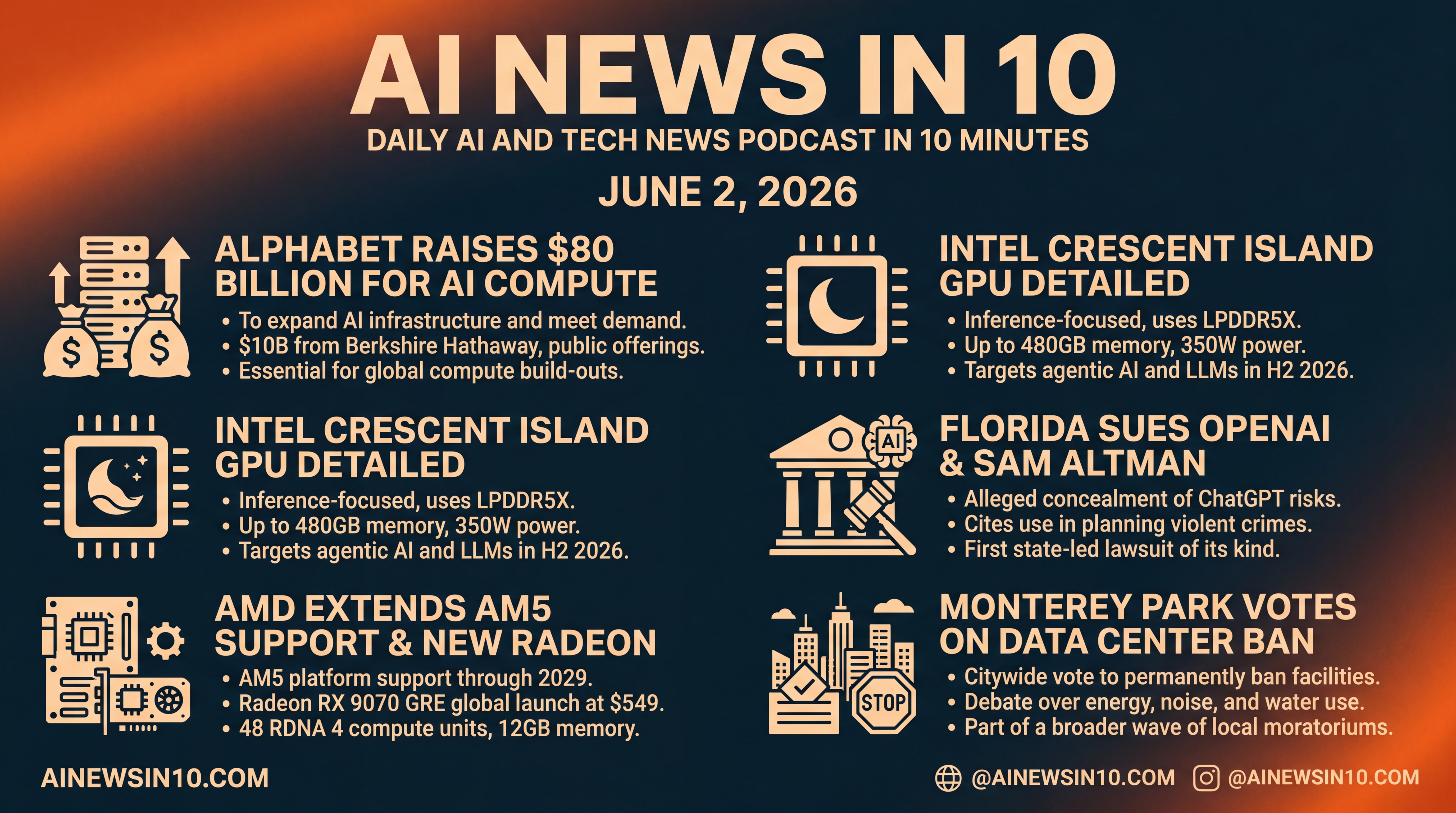
Episode Infographic
Show Notes
Welcome to AI News in 10, your top AI and tech news podcast in about 10 minutes. AI tech is amazing and is changing the world fast, for example this entire podcast is curated and generated by AI using my and my kids cloned voices...
It’s Tuesday, June 2, 2026 — and today’s AI and tech rundown is stacked.
Alphabet is raising a jaw-dropping 80 billion dollars to feed its AI compute ambitions... Intel just detailed an inference-focused GPU that dodges the HBM crunch... AMD is sweetening the PC upgrade path through 2029 and shipping a new Radeon today... Florida has sued OpenAI and Sam Altman over alleged ChatGPT risks... and in Southern California, a citywide vote could ban data centers outright.
Let’s get into it.
[BEGINNING_SPONSORS]
Story one: Alphabet just put a massive financial marker down on the future of AI.
Google’s parent says it’s raising up to 80 billion dollars to expand AI infrastructure as demand outstrips current capacity. That includes a 10 billion dollar private placement from Berkshire Hathaway, roughly 30 billion via underwritten offerings, and another 40 billion through an at-the-market program rolling out later this year.
Shares dipped a little over two percent on the news, but the company called the raise essential to meet unprecedented customer demand. Euronews reports that a hefty portion will go straight to AI-related capital spending — and Berkshire’s involvement is being read as a vote of confidence.
For context, Alphabet had already signaled 2026 capital expenditures between 180 and 190 billion dollars — a reminder that scaling AI is now an energy and compute problem that requires industrial-scale cash. That spending arc sets the backdrop for this equity move. TechCrunch and others say the aim is global compute build-outs, not one-off projects.
Regional outlets echo the structure: public offerings, the at-the-market program, and Berkshire’s direct buy — with multiple reports highlighting the 10 billion dollar commitment from Warren Buffett’s firm. If you’re tracking the AI capex arms race, this is the headline of the day.
Story two: over in Taipei at Computex, Intel is filling in the blanks on its next data center AI accelerator, codenamed Crescent Island.
The new card targets inference efficiency and swaps scarce HBM stacks for LPDDR5X. Intel says designs will start at 160 gigabytes and can scale to 480 gigabytes of on-card memory, all at a 350-watt power target. It’s pitched as built for agentic AI, supporting data types from FP4 up to FP64, and aiming at everything from large language model inference to scientific workloads.
Tom’s Hardware reports that this wide and slow LPDDR5X approach could hit roughly 684 gigabytes per second of bandwidth — and, crucially, ease pressure on advanced packaging bottlenecks plaguing HBM supply. The target window is the second half of 2026.
Why this matters: as model contexts stretch and multi-agent orchestration becomes standard, memory capacity — not just raw TOPS — can be the bottleneck. Intel’s bet is that massive LPDDR capacity close to the die will keep more tokens, tool use, and state resident, lowering latency and cost per query. If that holds in production, buyers juggling inference economics may welcome another option that’s air cooled and drop in friendly for conventional four U racks.
Story three: AMD used Computex to deliver two headlines for PC builders.
First, it extended AM5 socket support through 2029 — giving DIY upgraders a longer runway. Second, the Radeon RX 9070 GRE, previously limited to China, goes global today at 549 dollars. It features 48 RDNA 4 compute units and 12 gigabytes of memory.
AMD’s own testing claims an average 21 percent uplift versus the competing RTX 5060 Ti across a broad 1440p suite. Tom’s Hardware and PC Gamer both note day one availability at that 549-dollar list price. It’s a value-play card slotted between the RX 9060 XT and the 9070, widening midrange options just as a fresh wave of AI-capable laptops and desktops rolls out.
If you’ve been waiting to refresh a rig, the promise of AM5 support through 2029 is arguably the bigger story — platform longevity spreads cost over time, especially helpful as DDR5 kits and GPUs navigate price spikes tied to AI demand. AMD is signaling stability for builders who want upgrades without motherboard churn.
[MIDPOINT_SPONSORS]
Story four: Florida has filed a civil lawsuit against OpenAI and CEO Sam Altman, alleging the company concealed serious risks tied to ChatGPT’s public release.
The complaint cites cases where alleged offenders reportedly queried ChatGPT while planning violent crimes, arguing that OpenAI ignored internal and external safety warnings. OpenAI, in a statement reported by the Associated Press, said its models steer users toward real-world support and that it cooperates with law enforcement — emphasizing that ChatGPT is a general-purpose tool used by hundreds of millions for legitimate purposes.
Florida’s attorney general called it the first in the nation, state-led lawsuit of its kind. The case raises novel questions about product liability, content moderation, and the standard of care for general-purpose AI.
Axios’ local coverage flagged the state’s escalating posture, which has included a separate criminal probe this spring. However this proceeds, watch for other states to mirror Florida’s theory — or distance themselves if courts push back. Either way, it’s a test of where AI safety promises meet accountability.
Story five: a first-of-its-kind local vote on the AI infrastructure boom lands today in Monterey Park, just east of Los Angeles.
Residents are weighing Measure N D C, which would permanently ban data centers inside city limits — reversible only by another public vote. The proposal follows a fight over a 247,000 square foot facility proposed near homes. Reporting notes the site could have drawn roughly 50 megawatts at peak — no small ask for a city of about 60,000 people.
The Los Angeles Times says the measure arrives amid a broader wave of local moratoriums and restrictions nationwide, as communities debate noise, energy load, water use, and air quality impacts from hyperscale projects. If it passes, expect ripple effects in nearby cities weighing their own rules.
One more labor-and-infrastructure note from the Los Angeles Times business desk: Meta detailed California layoffs tied to its 10 percent workforce reduction — about 2,200 roles in Menlo Park and 74 in Playa Vista — as the company redirects spending toward AI. It’s a tangible example of how AI’s cost curves are reshaping tech payrolls and capital budgets in tandem.
Quick recap... Alphabet’s 80 billion dollar raise underscores that AI leadership is now gated by energy and compute — not just clever algorithms. Intel’s Crescent Island bets on massive LPDDR5X pools to make inference cheaper and easier to deploy. AMD gives builders a longer-lived AM5 platform and a 549-dollar GPU option. Florida’s suit against OpenAI previews the next chapter in AI liability. And a Southern California city is asking voters whether data centers should be banned outright.
Busy day — more tomorrow as these stories develop.
Thanks for listening and a quick disclaimer, this podcast was generated and curated by AI using my and my kids' cloned voices, if you want to know how I do it or want to do something similar, reach out to me at emad at ai news in 10 dot com that's ai news in one zero dot com. See you all tomorrow.
