Agentic Apps, OpenAI on Bedrock, Terafab Bets
Build Day Two shifts from demos to delivery, as Microsoft pushes agentic app patterns and Copilot upgrades. Plus: OpenAI models land on Amazon Bedrock, the EU links AI with energy policy, the US opts for voluntary model reviews, and SpaceX’s Terafab megaproject hits a pivotal hearing.
Episode Infographic
Show Notes
Welcome to AI News in 10, your top AI and tech news podcast in about 10 minutes. AI tech is amazing and is changing the world fast, for example this entire podcast is curated and generated by AI using my and my kids cloned voices...
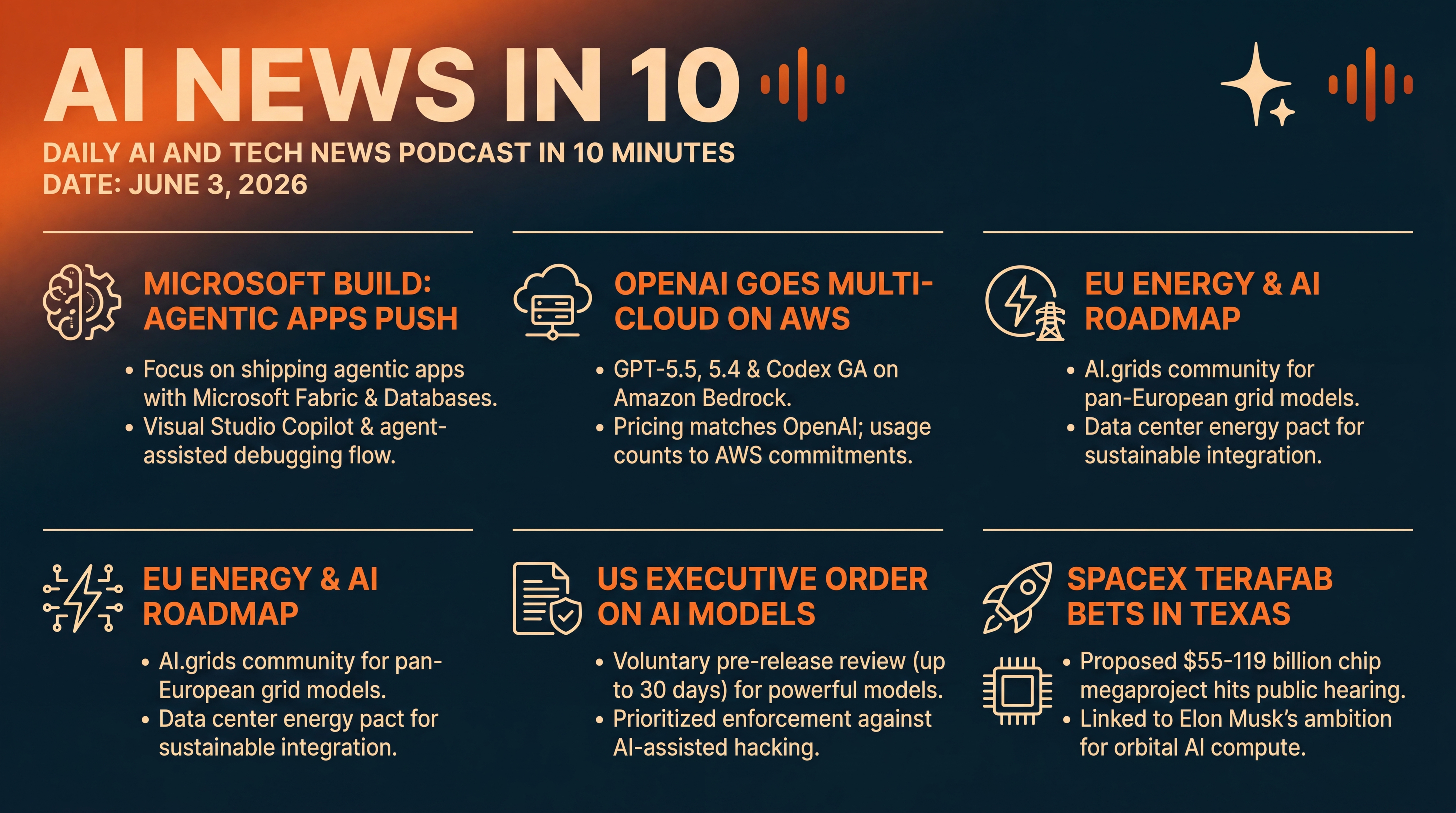
Here’s what’s moving in AI and tech this Wednesday, June 3, 2026... We’re diving into Day Two of Microsoft Build — the push for truly agentic apps — plus fresh Copilot and developer updates. There’s a major cloud shake‑up, too: OpenAI’s latest models are now generally available on Amazon Bedrock. In Europe, the European Commission is adopting a strategic roadmap that ties AI directly to energy systems — and it’s launching a grid AI community and a data‑center energy pact the same day. We’ll also unpack yesterday’s United States executive order that gives the government an early look at powerful AI models — voluntarily, not by mandate. And we’ll close in Texas, where SpaceX’s proposed Terafab — a 55 to 119 billion dollar chip megaproject — hits a key public hearing this morning.
[BEGINNING_SPONSORS]
Let’s start with Microsoft Build, running June 2 and 3 in San Francisco. Today’s emphasis is on actually shipping agentic applications — apps that can reason, plan, call tools, and coordinate tasks across your data platforms.
Azure and the data teams are highlighting patterns for building agentic apps with Microsoft Fabric and Microsoft Databases, with sessions walking through orchestration, governance, and performance on Fabric’s data warehouse. Live coverage even touted internal benchmarks — up to seven times faster on certain analytics scenarios — underscoring the performance angle behind all this agent talk.
Meanwhile, the Visual Studio team is previewing what’s next, bringing Copilot, Visual Studio Code, and Visual Studio together for a more agent‑assisted debugging and profiling flow — and a tighter Copilot loop inside the I D E.
In short, Day Two is the how to yesterday’s what — pushing developers toward intent‑first patterns and responsible guardrails, not just raw model calls.
Sources: Microsoft Azure Blog on Build; Microsoft’s Build live blog; Visual Studio team’s Build update.
Quick take: Why it matters... Developers are increasingly judged not just by what large language model they call, but by how they wire agents into real data and workflows under enterprise governance. Microsoft is making Fabric the gravity center for that story. Expect a summer of agent refactors in enterprise backlogs.
Story two: OpenAI just went multi‑cloud in practice for a lot of enterprises. On June 1, Amazon Web Services announced general availability of OpenAI’s G P T 5 point 5 and 5 point 4 — and Codex — on Amazon Bedrock. Crucially, pricing matches OpenAI’s first‑party rates, and usage counts against existing A W S spend commitments.
For developers, Codex support shows up across the Codex app, the command‑line tools, and I D E integrations — now configurable to route inference through Bedrock. From OpenAI’s side, the move is about giving customers frontier capabilities on infrastructure you already trust — and a faster path to production. Translation: procurement, security reviews, and budget alignment go green in A W S shops that were previously gated by Azure requirements.
Sources: A W S What’s New; OpenAI announcement.
A few implications... One — portability pressure goes up, since multi‑cloud footprints get easier when the same models fit A W S governance and logging. Two — expect tooling to converge; we’re already seeing OpenAI‑compatible Responses A P I s light up for Bedrock scenarios. And three — the agent platform wars will increasingly be fought inside the big clouds’ security and data perimeters, not just on standalone endpoints.
Story three heads to Brussels. The European Commission is adopting, today, a strategic roadmap for digitalization and AI in energy — and immediately launching two flagship initiatives.
First, AI.grids — a community of practice aimed at piloting pan‑European foundation models for grid management and planning. Second, a Declaration of Intent among fourteen industry associations to sustainably integrate data centers into Europe’s energy system through E U‑level tripartite agreements between operators, energy parties, and public authorities.
The program puts technological sovereignty, governance, and long‑term model stewardship on the table for critical infrastructure — making this as much industrial policy as it is AI policy.
Sources: European Commission energy event materials for June 3.
Why it’s notable: Europe spent the past few years regulating AI. This is a pivot to deployment — where power, compute, and policy intersect. If AI.grids lands credible foundation models for grid planning, and the data‑center accords become real contracts, you’ll see faster grid interconnects, demand shaping, and energy‑aware AI siting across the bloc.
[MIDPOINT_SPONSORS]
Story four: In Washington, President Trump signed an executive order on Tuesday, June 2, that asks AI developers to voluntarily give the government an early look — up to 30 days — at powerful new models before public release. The text underscores that nothing in the order creates mandatory licensing or preclearance. It does, however, prioritize enforcement against AI‑assisted hacking, calling on the Justice Department to treat certain AI‑enabled intrusions as a high priority.
Industry reactions frame it as a narrower approach than earlier drafts that reportedly floated a longer review window. For developers shipping frontier systems this summer, the headline is voluntary pre‑release coordination over compulsion — paired with a tougher posture on AI‑aided cybercrime.
Sources: C B S News; The Washington Post; TechCrunch summary of the order.
What to watch: Whether major labs publicly commit to standardized, time‑boxed federal evaluations — especially for cybersecurity red‑teaming — and whether agencies can stand up credible, confidential testing in time to matter for the next wave of releases.
And story five is in Texas, where SpaceX’s proposed Terafab — a multi‑phase, vertically integrated semiconductor facility — hits a public hearing at 9 a.m. local time today in Grimes County. Public filings and notices peg the project’s initial spend around 55 billion dollars, with an upper bound reported at 119 billion if fully built out. Today’s hearing focuses on property tax abatements and the formal designation of a reinvestment zone.
Reporting has linked the site to the former Gibbons Creek power property, and industry coverage has tied the broader plan to Elon Musk’s ambition for orbital AI compute — an idea that would eventually require massive chip output and packaging capacity. SpaceX has reportedly been discussing foundry assistance, including with Intel, while community groups and local media have flagged environmental and transparency questions ahead of the vote.
Sources: Grimes County public meeting notice; Supply Chain Dive; Tom’s Hardware; The Register.
Bottom line: Even if approvals take months, this is the most audacious single‑site chip proposal we’ve seen — on par with nation‑state‑scale investments. Whether it lands in Grimes County or elsewhere, the signal is clear: the AI compute race is starting to pull chipmaking strategy into entirely new geographies — and, if Musk gets his way, new orbits.
Quick recap... Microsoft Build Day Two is about turning agent ideas into governed, high‑performance apps. OpenAI’s frontier models are now generally available on Amazon Bedrock, bringing cloud‑native governance to multi‑cloud adopters. The EU is marrying AI with energy policy — launching AI.grids and a data‑center energy pact as it adopts a new roadmap. The United States signed an executive order for voluntary model pre‑release reviews while elevating the fight against AI‑aided hacking. And in Texas, SpaceX’s colossal Terafab chip project faces its first big public test. We’ll keep watching what ships, what’s regulated, and where the next megafab — and megacloud — land next.
Thanks for listening and a quick disclaimer, this podcast was generated and curated by AI using my and my kids' cloned voices, if you want to know how I do it or want to do something similar, reach out to me at emad at ai news in 10 dot com that's ai news in one zero dot com. See you all tomorrow.
