Apple’s AI Pitch, Chrome’s Shift, and Power Questions
WWDC’s AI push, Chrome’s AI-first tests, a UN warning on power and water, London Tech Week’s signals, and OpenAI’s plan changes — here’s what matters and why. Fast, clear takeaways to help you plan your week.
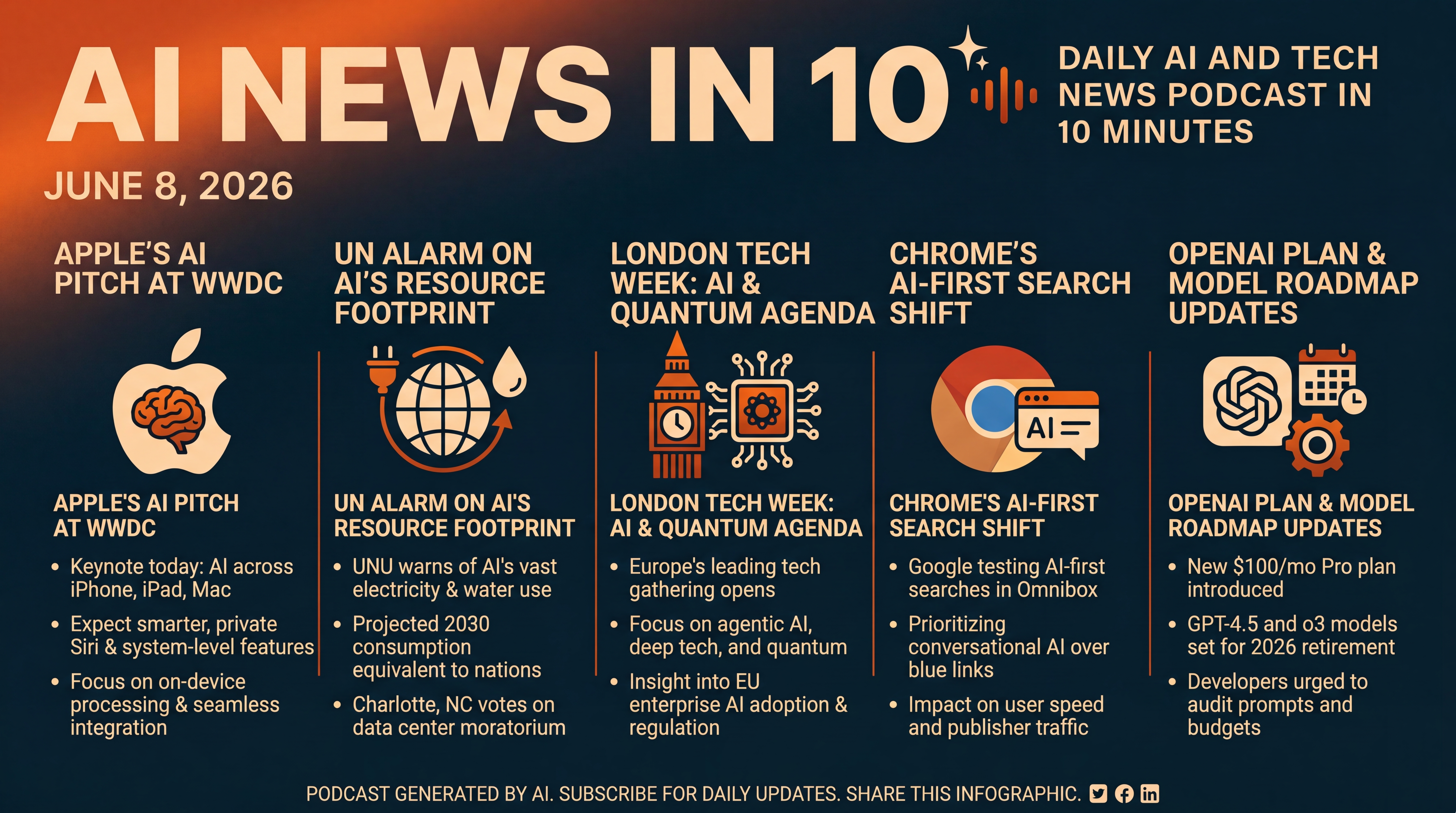
Episode Infographic
Show Notes
Welcome to AI News in 10, your top AI and tech news podcast in about 10 minutes. AI tech is amazing and is changing the world fast, for example this entire podcast is curated and generated by AI using my and my kids cloned voices...
It’s Monday, June 8th — a big day in tech. Apple’s WWDC 2026 keynote lands this afternoon with AI front and center… the United Nations’ academic arm is warning about AI’s growing appetite for electricity and water, with a timely city vote on data centers today… London Tech Week opens with AI and quantum driving the agenda… Google is testing AI‑first searches in Chrome… and OpenAI quietly updated ChatGPT plans and model timelines. Let’s get into it.
[BEGINNING_SPONSORS]
Story one — WWDC day finally arrives. Apple’s Worldwide Developers Conference kicks off today, with the keynote at 10 a.m. Pacific, 1 p.m. Eastern. Apple is teasing AI advancements across its platforms, and reports are priming expectations around a more capable, more private Siri — plus deeper system‑level AI features on iPhone, iPad, and Mac. It’s a developer show, so think frameworks and tools… but the spotlight is clearly on AI this year. Apple notes the Keynote and the Platforms State of the Union both land today, with sessions all week. And yes… those times are firm.
What to watch for: whether Apple keeps more processing on‑device for privacy, how Siri handles multi‑step tasks, and how much rolls out immediately versus in developer betas. If Apple nails day‑one use cases that feel seamless — messaging, mail, photos, reminders, calendar — it could reset the AI assistant conversation. But if features feel gated behind subscriptions or narrow regions, expect muted reactions. Apple’s own language emphasizes AI advancements without over‑promising… so expect careful framing today, then a deluge of labs and documentation all week.
Story two — the UN University rings an alarm on AI’s resource footprint. New analysis from the United Nations University Institute for Water, Environment and Health estimates that by 2030, data centers powering AI could consume around 945 terawatt‑hours of electricity annually — nearly triple the combined annual use of Pakistan, Bangladesh, and Nigeria. On water, the same work projects AI‑related consumption equivalent to the basic domestic needs of 1.3 billion people, alongside a land footprint topping 14,500 square kilometers and up to 2.5 million tons of e‑waste each year. The report isn’t anti‑AI — the authors urge moving beyond a carbon‑only lens and balancing carbon, water, and land impacts in planning.
That context lands as local governments wrestle with the AI build‑out. In Charlotte, North Carolina, the City Council is scheduled to vote today on a 150‑day moratorium on new data‑center applications to study power, water, and health impacts. Whether it passes or not, it underscores how quickly AI infrastructure has become a local land‑use and utilities story — not just a Silicon Valley story. Expect more councils to ask… where do we put this, who pays for grid upgrades, and how do we conserve water?
One more data point: coverage of the UN analysis highlights the potential electricity spike and notes that many U.S. water utilities haven’t fully priced in AI‑driven growth. Even with clean‑energy procurement, grid modernization and water planning have to keep pace. This is the headwind every AI roadmap now has to factor.
Story three — London Tech Week opens today, with AI and quantum center stage. The conference runs June 8th through 10th at Olympia London, with a broader citywide program through the 12th. Organizers bill it as Europe’s leading tech gathering and are leaning hard into agentic AI, deep tech, and quantum. One preview highlights over 30,000 attendees and thousands of startups and enterprise leaders converging, with dedicated deep‑tech programming. If you track enterprise AI adoption, London this week is a rich signal — how European buyers are budgeting for AI, where they see ROI now, and where quantum pilots might intersect with AI workloads.
For U.S. listeners, London Tech Week often surfaces different constraints than Bay Area conferences — think data residency, EU regulatory timelines, and sector‑specific safety considerations. If you’re selling or buying AI into Europe, pay attention to panels around compliance with the EU AI Act — and how companies are preparing for high‑risk system obligations over the next 24 months.
[MIDPOINT_SPONSORS]
Story four — Google is testing a big shift in how Chrome handles searches from the address bar. Some users are seeing experiments where typing a query into Chrome’s omnibox routes you straight into an AI Mode conversation rather than the familiar list of blue links — essentially making AI the front door for certain builds. To be clear, this is a limited test, not a wholesale switch. Still, it’s notable: Google has already embedded AI Mode into the address bar this year, and this goes a step further by prioritizing an AI response flow.
What it means for users and publishers: expect continued experimentation around when you see a traditional results page versus an AI thread. For end users, the benefit is speed and conversational follow‑ups. For sites that rely on search traffic, it raises familiar questions — how much traffic do AI answers siphon, and what does attribution mean when the AI sits between you and the link? Google tends to iterate fast here… so if your product depends on organic search, watch the Chrome release channels closely over the next few weeks.
Story five — OpenAI has updated ChatGPT’s plan and model roadmap, with implications for developers and power users. Release notes introduce a new $100‑per‑month Pro plan and set retirement dates for two well‑known models: GPT‑4.5 leaves ChatGPT on June 27, 2026, and the o3 family retires on August 26, 2026 — following standard notice windows. If your prompts or eval harnesses are tied to those models, now’s the time to regression‑test on the designated successors. The notes also mention updates to deep‑research features and how Codex usage is counted across Plus and Pro tiers. If you’re managing spend or SLAs, the pricing and deprecation schedule are the practical headlines today.
Stepping back, you can see the week’s through‑line. On the consumer side, Apple is about to pitch AI that’s more useful and more private… on the platform side, Google is probing how far it can move everyday browsing into AI flows… and on the infrastructure side, cities and utilities are asking whether power and water plans can keep up — just as Europe firms up enforcement for its AI rulebook and London convenes buyers and builders.
That’s it for today’s rundown. Apple’s WWDC keynote hits this afternoon — watch for how deep AI runs in the core apps… the UN report keeps the resource debate squarely in view… London Tech Week should surface enterprise AI priorities… Chrome’s AI experiments hint at the next phase of web search… and OpenAI’s plan and model changes are your nudge to audit prompts and budgets. We’ll be back tomorrow with what Apple actually shipped — and how the market reacts.
Thanks for listening and a quick disclaimer, this podcast was generated and curated by AI using my and my kids' cloned voices, if you want to know how I do it or want to do something similar, reach out to me at emad at ai news in 10 dot com that's ai news in one zero dot com. See you all tomorrow.
