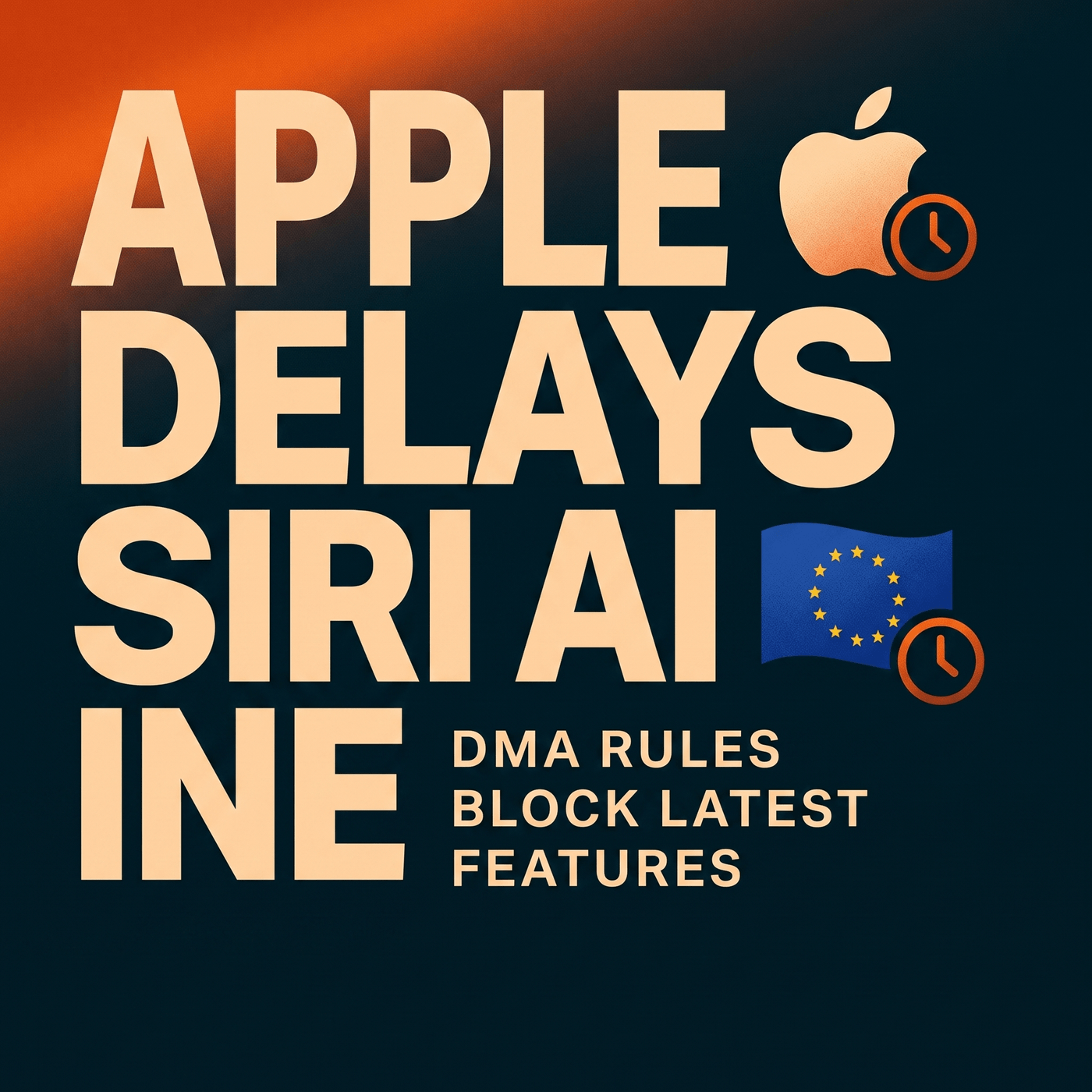
Siri Stalls in EU, OpenAI Eyes IPO
Apple delays its revamped Siri in the EU as DMA rules bite, while OpenAI quietly files for an IPO. Plus an urgent Check Point VPN patch order from CISA, Windows 11’s AI-friendly June update, and a GitHub supply-chain attack targeting AI developers.
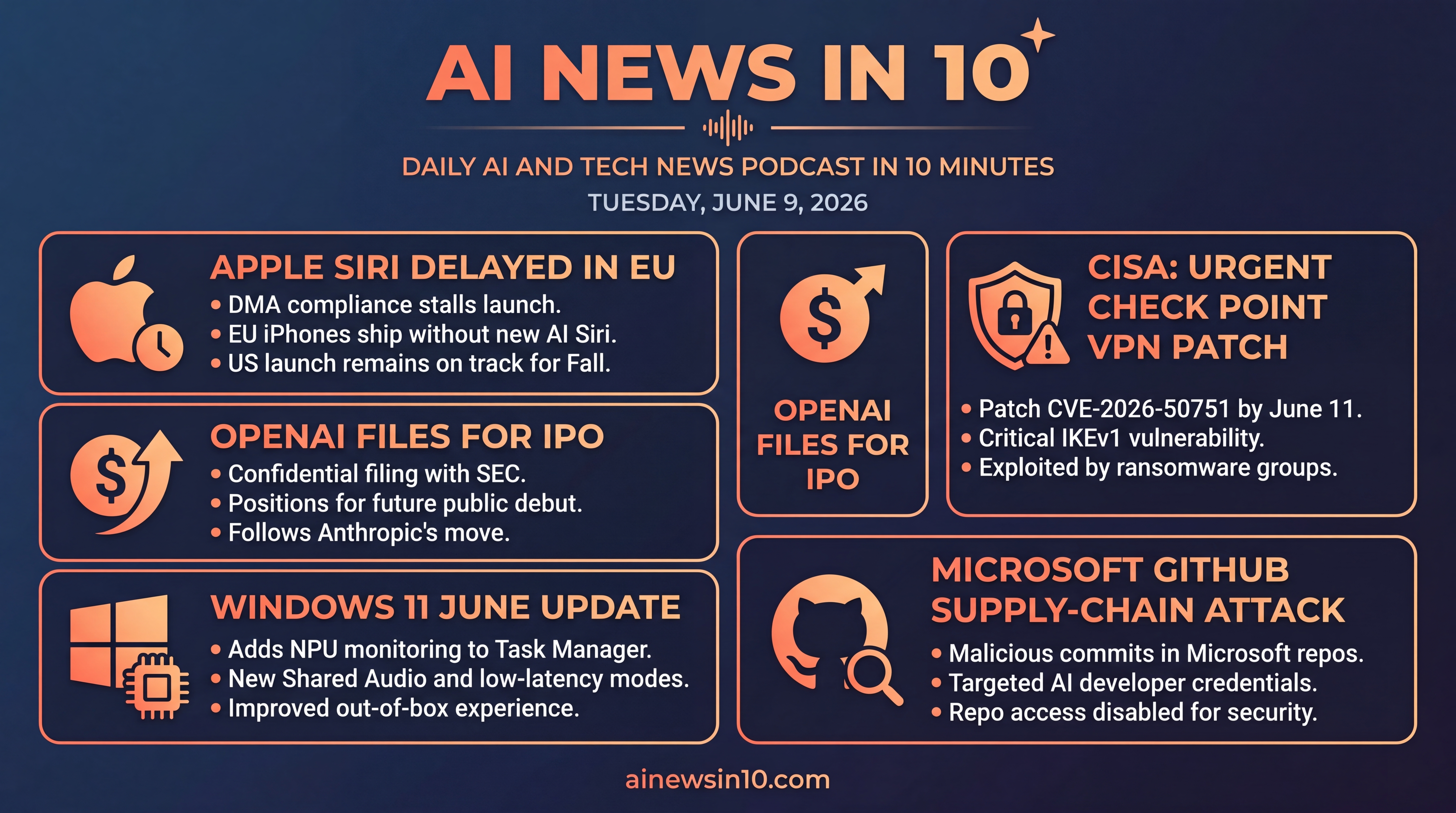
Episode Infographic
Show Notes
Welcome to AI News in 10, your top AI and tech news podcast in about 10 minutes. AI tech is amazing and is changing the world fast, for example this entire podcast is curated and generated by AI using my and my kids cloned voices...
Here’s what’s making waves in AI and tech today — Tuesday, June 9, 2026.
Apple’s overhauled Siri won’t launch in the European Union this fall... regulatory friction under the Digital Markets Act is the sticking point. OpenAI has confidentially filed for an IPO... positioning for a Wall Street debut as the AI funding race hits an inflection point. On the cybersecurity front, CISA is giving federal agencies just three days to patch a Check Point VPN zero-day exploited by ransomware groups. Meanwhile, Microsoft is rolling out June updates for Windows 11 — with NPU monitoring and other AI-era touches. And finally, Microsoft is investigating a supply-chain attack against open-source tools on GitHub that targeted AI developers’ credentials.
[BEGINNING_SPONSORS]
Let’s start in Cupertino... and Brussels.
Apple’s big Siri reboot, showcased yesterday, won’t arrive in the EU when iOS 27 and iPadOS 27 ship this fall. Apple says interoperability requirements under the DMA make the current design impossible to launch right now. The company says EU officials have refused to engage on a workable compliance path, so it’s delaying the Siri AI rollout on iPhone, iPad, and Apple Watch in the bloc while it works through the rules.
Across Europe, outlets say EU iPhones will initially ship without the AI-enabled Siri — highlighting how the DMA’s default-service and access provisions complicate deeply integrated assistants. The U.S. launch remains on track for the fall, and the revamped assistant leans on a partnership with Google for certain cloud AI tasks, even as Apple stresses on-device privacy for many features. Watch for whether Apple ships a pared-back EU version, waits for guidance, or negotiates API parity for rival assistants — that’s the core DMA tension.
Why this matters: the DMA’s requirement that gatekeepers offer equivalent access to key platform hooks could reshape how agentic assistants work on phones. If Apple must expose the same on-screen action and data interfaces to competitors, we may see a real market test — Siri versus Gemini versus others — on truly level technical footing. That’s a policy experiment with global implications.
Next up... OpenAI has quietly taken the first formal step toward going public.
Late Monday, the company said it has confidentially filed draft IPO documents with the SEC. The confidential route lets OpenAI and its bankers refine the filing outside the spotlight — then release a full S-1 when the timing is right — while they gauge market conditions. It follows Anthropic’s confidential filing on June 1, setting up a rare scenario where two of the most-watched AI labs could reach public markets in the same window. OpenAI frames the move as positioning rather than an imminent debut, while the filing gives the company optionality to raise at scale as compute needs accelerate.
Key questions ahead: governance under a public, capped-profit structure... the durability of enterprise copilot revenue... and how any post-Microsoft distribution deals factor into growth.
If you run security... here’s today’s red-flag alert.
CISA is ordering federal civilian agencies to patch a critical Check Point Remote Access and Mobile Access VPN vulnerability — tracked as CVE-2026-50751 — within three days, by Thursday, June 11. The flaw allows unauthenticated attackers to bypass authentication and establish VPN sessions on devices still using deprecated IKEv1 configurations. Check Point pushed fixes yesterday after observed exploitation spiked over the weekend, and at least one incident is linked to a Qilin ransomware affiliate.
CISA has added the CVE to its Known Exploited Vulnerabilities catalog under Binding Operational Directive 22-01 — requiring rapid mitigation or discontinuation of vulnerable services. If you can’t patch today, vendors advise disabling legacy remote-access clients, enforcing IKEv2 only, and requiring machine-certificate authentication... then patch as soon as possible.
[MIDPOINT_SPONSORS]
Over to Redmond — Windows 11’s June update begins rolling out today.
While it’s nominally a security release, Microsoft slipped in several consumer-visible enhancements and AI-era telemetry. You’ll see Shared Audio to let two listeners pair to a single device... new low-latency modes... the ability to stream a camera feed to multiple apps... an improved out-of-box experience with custom user-folder naming... and a reworked Task Manager that exposes NPU utilization — helpful as NPUs become standard on new PCs.
The rollout starts today through Microsoft’s controlled feature release cadence, so don’t panic if features take a few days to show up. For IT, this patch train is also tied to a long-running Secure Boot certificate transition that’s been staged since earlier this year. Bottom line: it’s a Patch Tuesday that mixes security with small but meaningful quality-of-life upgrades — plus better AI observability.
And we close with another security story reshaping developer workflows.
Microsoft is investigating a supply-chain attack that led GitHub to disable dozens of Microsoft-owned repositories late last week, after researchers found malicious commits designed to steal credentials when certain AI coding tools opened the projects. The payload targeted environments using tools like Claude Code, Gemini’s CLI, Cursor, and Visual Studio Code — focusing less on package-install hooks and more on open-the-folder actions. Seventy-three Microsoft repos across four GitHub orgs were taken offline at the peak as a precaution, with guidance for developers to rotate tokens and keys if they cloned and opened affected repos since June 2. Microsoft says some repos have since been restored and that it directly notified a small number of customers who might be impacted.
The big lesson: as AI dev tools integrate ever more deeply with code and terminals, classic supply-chain risks are meeting a new, IDE-centric attack surface. Security teams should extend guardrails and scanning to editor configurations and project workspaces — not just dependencies.
Quick recap...
Apple’s Siri AI is delayed in the EU as DMA rules bite. OpenAI has confidentially filed for a U.S. IPO. CISA’s three-day clock is ticking on a Check Point VPN zero-day. Windows 11’s June update lands with AI-friendly tweaks and telemetry. And Microsoft is probing a GitHub supply-chain attack aimed at AI developers.
We’ll keep tracking how regulation, security, and platform shifts are reshaping the AI stack — one patch, one policy, and one product at a time.
Thanks for listening and a quick disclaimer, this podcast was generated and curated by AI using my and my kids' cloned voices, if you want to know how I do it or want to do something similar, reach out to me at emad at ai news in 10 dot com that's ai news in one zero dot com. See you all tomorrow.
